
How Russia Attacks Ukrainian Medical Infrastructure
AUTEUR : Dzvenyslava Shcherba
AuthorSince the beginning of the full-scale invasion, Russia committed 1067 attacks on Ukrainian medical facilities.
Since 24 February 2022, Ukrainian medical facilities have been targeted by the Russian military. Due to their scale and systemicity, they may potentially be deemed to meet the threshold for crimes against humanity. According to the World Health Organisation,1067 attacks on Ukrainian medical facilities, infrastructure, transport, medical personnel and patients were committed from 24 February 2022 to 27 July 2023.

“Systemicity and intentionality of attacks points to the approval of this tactic at the level of Russia`s senior military and political authorities. Attacks on the healthcare system are approved and even fostered as methods of warfare and terror against civilian population”, — Diana Rusnak, the analyst at Ukrainian Healthcare Center notes.
Russia attacks medical facilities using different types of weapons. In some cities, these attacks destroyed practically the whole municipal medical infrastructure. For instance, during March and April 2022, at least 80% of medical infrastructure in Mariupol were destroyed.
“There are various examples of such attacks - Mariupol maternity hospital, attack on the Chernihiv city center on 3 March 2022 that damaged the cardiology center, the recent attack on a medical facility in Huliaipole, Zaporizhia region on 9 June 2023. The use of aviation for bombing of civilian infrastructure and medical facilities in particular points to the intentionality of these attacks, as aviation targets coordinates that are approved by the senior commanding”, — Rusnak explains.
Another example of attacks on medical facilities are shellings of medical transport and medical facilities that were marked by red crosses on white canvas. This mark is an internationally approved sign of medical facilities that certifies their protection under the international humanitarian law. However, the Russian military kept attacking medical transport and facilities in spite of these signs. Ukrainian Healthcare Center documented one such attack: during March 2022, Russian troops shelled the building of Izium Central Municipal Hospital three times in spite of the fact that medics had set white canvas with a red cross on the roof.

According to human rights organisations, Russia uses attacks on medical facilities as methods of warfare. The same tactic was used during Chechen wars, Russian war against Georgia and conflict in Syria. From 2015 to 2016, when Russia was the most involved in combat actions, 266 attacks on medical facilities occurred. As for today, it is the biggest number of attacks on Syrian medical infrastructure.
Russian propagandists share narratives about the using of Ukrainian medical facilities for military purposes to justify attacks. For example, the attack on Mariupol maternity house on 9 March 2022 was justified with statements that the hospital was used as “the Azov military base” and patients or medical personnel were sent away from the building.
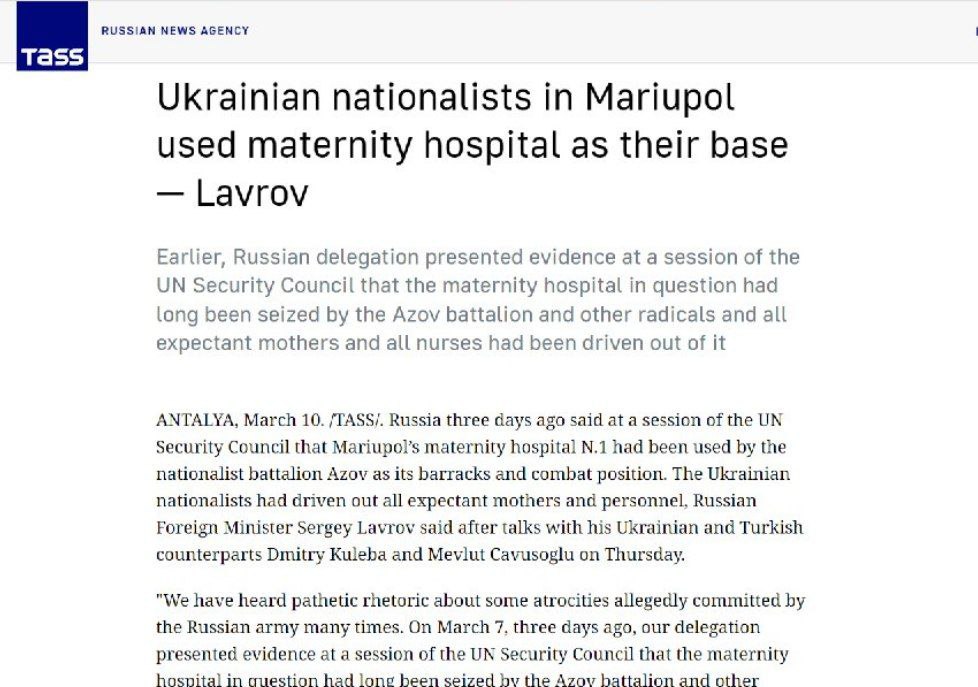
At the same time, Russian propagandists also try to accuse Ukraine's Armed Forces of Russia's own war crimes. This approach is used to justify shellings of other objects of civilian infrastructure. In addition to justifying Russia's actions, it aims at demonising the Ukraine`s Army and nourishing a bigger narrative about Ukraine as a “terrorist state”.
One more example of Russian war crimes is occupying medical facilities in temporarily occupied Ukrainian territories.
“Russians` behaviour in temporarily occupied territories had the following pattern. At first, they shelled the medical facility when it was still used either for humanitarian purposes or as a bombing shelter. Then they occupied the facility together with its territory, and used it for their purposes. Lastly, when they had to leave it, they destroyed and looted the facility, took its property and mined the territory”, — explained Rusnak.
During combat actions near cities, the medical personnel and patients left alone under the risk of shelling, absence of the access to water, food, hygiene tools, heat and electricity supplies.
“The food became very poor. Electricity and water were turned off several times. We were just freezing there. As far as public transport stopped, nobody could come and bring us something. The shops in the hospital territory also didn't work. I would say that we were starving. We heard explosions all the time. The missile hit our catering department. We were woken up at night because of the alarm and were getting ready to go to the cellar with potatoes, as there wasn't any other bombing shelter. However, we had not been taken there. It was very hard when there was no water, as there were 50 of us. It was very cold. Sometimes I cried from hunger”, — recalls Olena.
She had been under treatment in one of Kherson hospitals when the full-scale war began and Kherson became occupied.
According to the Ukrainian Healthcare Center, medical facilities after their occupation are used for treatment and rehabilitation of Russian troops. Civilian population faces limits in access to medical services.
However, there are also stories of resistance. In spite of attacks and occupation, Ukrainian medics kept working and helping people during the war. The chief doctor of the Irpin Central Municipal Hospital Anton Dovhopol not only remained in the hospital together with other doctors, but also coordinated the work of medical facilities in Irpin, Bucha and Vorzel till their evacuation on 12 March 2022.
“Irpin hospital evacuated on 5 March when the shelling of the hospital infrastructure began. We made a decision to evacuate doctors so that nobody was wounded. Moreover, 90% of the Irpin population were evacuated… At the same time, medical facilities in Bucha and Vorzel were occupied. We remained under the occupation from 4 to 12 March. We managed to evacuate Vorzel hospital on 9 March and Bucha - on 12 March. In addition to evacuating the Bucha hospital, we also managed to evacuate approximately 1000 civilians”, — recalls Dovhopol.
In spite of the fact that the green corridor for evacuation was blocked, medics managed to evacuate the personnel, patients, costly equipment and a group of people who were trying to flee Bucha.
“When we were leaving Bucha on 12 March, the evacuation corridor got blocked. However, due to our decision to go and a big group of people, Russians thought by mistake that something had been changed and took us for the official corridor. When they understood that the corridor was not approved, they shelled us near the Zhytomyr root, but there was already our [Ukrainian] checkpoint… They shelled the column, tried to shoot us with the tank, but they didn't succeed and nobody got wounded”, — noted Dovhopol.
During the occupation, the hospital in Bucha was searched by the Russian military several times. In spite of pressure, doctors managed to hide and then evacuate to the military hospital wounded soldiers of the Ukraine's Territorial Defence. Their emergency car also kept driving through occupied parts of the Kyiv region and provided people with medical, humanitarian and information help.
“The only car that was driving through the region from 4 to 12 March 2022 was our ambulance. There was the Ukrainian flag on it. We were delivering humanitarian help, informing people about evacuation corridors, evacuating the wounded… We could have been shot, but everything turned safe”, — resumes Dovhopol.
Though buildings of medical facilities in all three cities were damaged by shelling, doctors returned to their workplaces on 1 April 2022 after the de-occupation of the Kyiv region. The work was restored during the next 2 weeks.

Medical facilities have a special status in all armed conflicts and are protected by the international humanitarian law and Geneva Conventions. They directly prohibit causing damage to medical facilities, violating their work, using them for military purposes or as a “human shield”. Therefore, systematic attacks on healthcare infrastructure, patients and medical personnel are war crimes committed by Russia against Ukraine.