
Crimes against the environment and ecocide: how the Russian invasion affects Ukraine's nature
AUTHOR: Alona Hryshko
AuthorRussians are ravaging Ukraine's environment. Nature hasn’t seen a negative impact on this scale since the Second World War.
The full-scale invasion by the Russian Federation has caused colossal damage to Ukraine: preliminary estimates alone put this figure at more than 2 billion hryvnias. According to reports from the Kyiv School of Economics and Zoï Environment Network, nearly 31% of the country's territory is under threat of an ecological destruction. The war has almost entirely destroyed over 20,000 square kilometers of Ukrainian land, with demining efforts believed to take a century at the least.
We spoke with experts about the repercussions of the war, ecocide, and crimes against the environment, which have become an integral part of the Russian army's war atrocities in Ukraine.
Ecocide and crimes against the environment: two sides of one war
Ecocide and war crimes against the environment are terms that relate to the impact of actions on the surrounding environment. War crimes are recognized as violations of international law and fall under the jurisdiction of the International Criminal Court. However, ecocide is a broader term that describes the extensive destruction of nature. History has known examples of the most extensive ecocides.
During the First and Second World Wars, humanity faced various crimes against the environment, escalating ecocide to horrifying levels. These events ranged from chemical attacks by German forces near the town of Ypres in 1915 to the blowing up of the Dnipro Hydroelectric Station dam in 1941 by Soviet authorities to halt the German army's advance. In 1986, the explosion at the Chernobyl NPP released toxic radioactive materials into the atmosphere — an amount even than the atomic bombings of Hiroshima. This disaster led to the formation of a radioactive cloud that spread across Europe.
However, the start of Russia's war against Ukraine on February 24, 2022, created a new reality. Daily, Russians commit crimes against the Ukrainian environment and people. In most cases, this involves deliberate destruction of Ukrainian natural resources — ecosystems, and industrial-infrastructure objects, leading to extensive pollution of nature. The lack of a clear international status for ecocide triggers discussions about it as a potential international crime. War crimes are violations of international law during wartime, whereas ecocide is classified as inflicting massive damage to the environment irrespective of the war context.
A third of Ukrainian forests affected by the war: centuries needed for recovery

Ukrainian ecosystems (ponds, meadows, fields), as well as animals, have become victims of military aggression and occupation: deforestation, soil, river, and lake pollution, as well as species extinction, are becoming increasingly common.
"Russia openly employs a scorched-earth policy on our territory," emphasizes Oleksiy Vasilyuk, a Ukrainian ecologist and co-founder of the Ukrainian Nature Conservation Group.

According to the Minister of Environmental Protection and Natural Resources of Ukraine, Ruslan Strylets, as of September 13, 2023, more than 3 million hectares of forests have been affected. This represents a third of all Ukrainian forests.
"Just within the Chernobyl Biosphere Reserve territory, at least 24,000 hectares of forest burned," says Oleksiy Vasilyuk. The ecologist adds that satellite images helped identify fires in the "Askania Nova" reserve, allowing the identification of the date and area of each fire. However, the extent of animal and plant losses remains unknown.
The destruction of vegetation, crucial for preserving soil and ecological balance, has become one of the consequences of the war.

Ukraine’s nature will need many centuries to restore destroyed trees, bushes, and plants - the time, however, incalculable. Lakes and rivers polluted during combat operations will take a lifetimes to return to their natural balance. Animals also suffer from changes in fauna, and the destruction of nature reserves and bio-reserves only exacerbates this problem.

"Today, everything that Ukraine has developed and preserved over the years of independence within the Emerald Network has been mostly destroyed or severely affected, especially in the territories of Eastern and Southern Ukraine. For instance, the Lower Dnieper National Nature Park, the regional landscape park 'Kinburn Spit,' the National Park 'Biloberezhzhya of Sviatoslav,' and others have suffered greatly," told Ruslan Havryliuk.
The environmental impact and air pollution during the war
The destruction and attacks on oil bases, oil refineries, and other infrastructure associated with oil products during wartime are extremely hazardous to the environment. Ecologist Oleksiy Vasilyuk believes that it's, at present, incredibly challenging to estimate the level of air or soil pollution because we lack primary indicators and don’t know what exactly exploded in these areas. It's quite possible that the next day this cloud of polluted air was already in another country, and rain quickly changed the composition of the soil.

The destruction of oil infrastructure has resulted in oil and petroleum product spills into the environment. This can lead to significant pollution of the soil, water resources, and air, damaging flora and fauna, and may have long-term consequences for ecosystems. Fires and explosions associated with oil products can pose a significant threat to human health due to the release of large amounts of harmful substances into the air. According to Vasilyuk, some of the largest incidents occurred in the first six months of the invasion: then after, the RF deliberately turned to a deliberate attack on oil bases — many facilities were destroyed by incredibly high precision missiles.

It is essential to remember that this pollution knows no boundaries and spreads far beyond Ukraine's borders.
Impact on the Population: Chronic Diseases and the Largest Forest in the Steppe
Soil, water, and air pollution also pose serious threats to the population’s health. Hazardous chemicals can enter the food chain through contaminated soil and water, leading to intoxication and illness.
An example is the deliberate sabotage of the dam of the Kakhovka Hydroelectric Power Plant (HPP) - a catastrophic event causing severe consequences for Ukraine and the region’s ecology. Russian occupiers committed this act of terrorism, which led to possibly the largest technogenic disaster in Europe in recent decades. The dam’s destruction resulted in an immense amount of uncontrolled water discharge from the Kakhovka reservoir.
"This has consequences not only for Ukraine but also for Bulgaria, Romania, Turkey, Georgia, and other neighbors in the Black Sea basin," emphasized researcher Ruslan Havryliuk.
The flooded territories not only suffered from water pollution and the destruction of flora and fauna but also cost Ukrainian lives. Eighty populated areas, including Kherson, ended up in the flood zone. Tens of thousands of people were held hostage to the flood, and local residents had to be evacuated from these areas of Kherson Oblast. According to Ruslan Havryliuk, this is not just an ecocide but could be considered a manifestation of genocide because the people of the left-bank part of Ukraine were not warned, thus leaving them defenceless to the mercy of the man-made flood organized by the Russians.
The Kakhovka reservoir played an important role in providing drinking water for the southern regions of Ukraine, including the temporarily occupied Crimea. After the dam was blown up, there was a shortage of drinking water, which caused serious consequences for the population. As emphasized by Havryliuk, the Russian aggressor disregards human lives and especially environmental issues.
According to the results of the study on drinking water in the Mykolaiv region conducted by the National Environmental Center of Ukraine (NECU), it was found that the quality of drinking water did not meet sanitary and epidemiological requirements. Therefore, the primary reason for the increased incidences of diseases among the population. Continuous consumption of this water could lead to chronic illnesses and exacerbate already existing diseases in the region. Ultimately, it could reduce the quality and duration of life to those susceptible.
"The non-compliance of these indicators with established requirements could potentially be the consequences of active combat operation in adjacent territories," explained Ruslan Havryliuk.
After the sabotage of the Kakhovka HPP, there is a heightened threat to the temporarily occupied Zaporizhzhia Nuclear Power Plant since it uses water from the Kakhovka reservoir to cool the nuclear reactors.
"Despite the drying up of the reservoir over time, nature begins to revive. However, we currently observe 3-meter willows instead of the usual ecosystem. That is, the former Kakhovka reservoir has become the largest forest in the steppe zone of Ukraine in just three months," commented Oleksiy Vasyliuk.
What's Next: Accountability and Reparations
Holding those responsible accountable is a task that requires joint efforts and international cooperation.
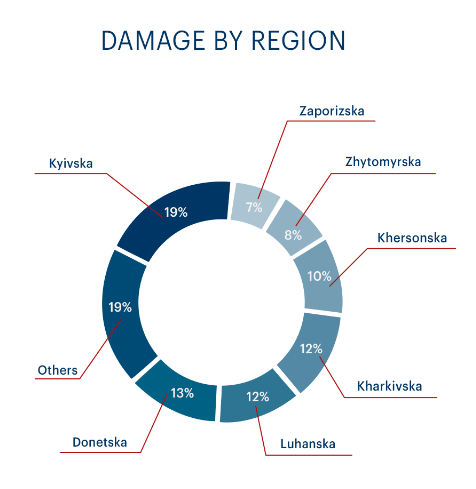
Oleksiy Vasyliuk emphasized that the data currently being collected by Ukrainian scientists will be invaluable in the future as it will directly demonstrate the changes that have occurred in one locality or another due to the war. However, in his opinion, we can evaluate only the qualitative damages.
The NECU noted that they studied the experience of Kuwait in 1991: according to the decision of a specially created UN compensation commission, the amount of claimed compensation was significantly less than what Kuwait demanded. In 1991, one of the most extensive environmental crimes occurred in the Persian Gulf during the war between Iraq and Kuwait. Iraqi forces blew up Kuwait's oil wells, causing fires that lasted for eight months. Enormous amounts of smoke, soot, sulfur dioxide, and carbon dioxide were released into the air daily, resulting in black rain within a radius of thousands of kilometers. These consequences led to severe human illnesses and reduced agricultural productivity.
As a result of this tragedy, an oil slick with an area of 10,000 km² formed in the Persian Gulf, leading to huge numbers of animal deaths. This became a significant historical example of punishment for crimes against the environment. In early 1991, the UN established a Compensation Commission to address Kuwait's claims for compensation for damages and losses.
"In Ukraine's case, a special structure should also be created and we should start gathering comprehensive evidence. Ukraine should appeal to international partners and organizations for assistance in collecting, analyzing, and verifying data on ecocide and environmental crimes. This assistance may include expert, technical, financial, and organizational support," says Oleksiy Vasyliuk.
He is convinced that Ukraine should first turn to international methodologies to gather evidence for international courts using defined procedures or it risks being left without reparations. It is also important to carefully investigate the data provided by the Ministry of Ecology and Natural Resources of Ukraine and determine the extent of the damages. This will serve as a guide for Ukraine’s compensation.
Despite everything, the use of international verification mechanisms through the judicial system to confirm the case of ecocide and determine the damages for compensation remains open.
Therefore, while the war continues, it is impossible to fully assess the damage caused to the environment. However, Ukraine's future requires the restoration of ecological stability and ensuring environmental safety. This is a significant challenge and, at the same time, an opportunity for the international community to show solidarity and support Ukraine and to hold Russia accountable for its crimes against the environment and human health.
The Russian war in Ukraine has a systematic impact on the environment, but with collective efforts, we can restore nature and ensure safety for all citizens.