


The story of Anna Yanko from the village of Yahidne, Chernihiv Oblast
AUTHOR:
Anna Yanko is one of the victims who the Russians locked in the basement of a local school for a month during the occupation of Yahidne in Chernihiv Oblast.
On 24 February, Anna and her parents left Chernihiv and went to her grandmother’s in Yahidne. On 3 March, Russian troops entered the village. Communication in the village immediately disappeared; a convoy of enemy vehicles drove along the Chernihiv–Kyiv highway, followed by street fighting and heavy shelling.
The Russians twice asked the family to go to the school basement but Anna and her family refused and remained at home. In the end, some drunk Buryats came for them, started reloading their automatic weapons and said that Anna’s family had five minutes to pack their things and go to the school.
They went there on foot, with the occupiers pushing them at automatic gunpoint. Once in the school basement, the family’s phones were taken and destroyed. By the time Anna entered the basement, it was so full of people sleeping on the floor that there was nowhere to walk.
On 8 March 8, the women were allowed to go home to collect essential belongings and get a decent meal, but there was nothing to collect, as the occupiers had looted every home. The residents of Yahidne lived in the school basement for a month. Sometimes they were let out, and sometimes they were kept inside for several days at a time. People asked to go to the lavatory and knocked on the door, but they were not always let out.
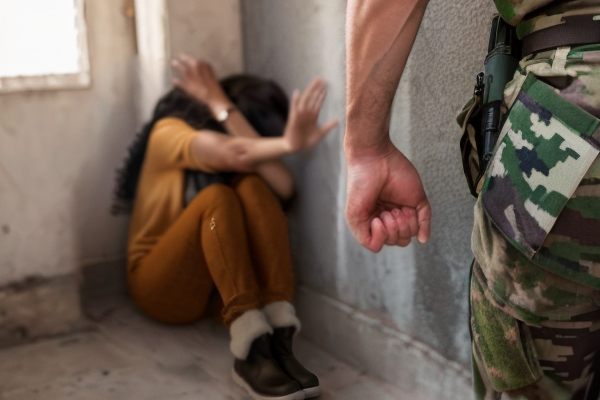
Anna herself was not injured during her stay in the basement but her parents, who asked to go home, were treated cruelly by the Russians. They dragged her mother by the hair to a neighbouring house and raped, and her father was continually beaten with rifle butts. Anna says that the occupiers took some people from the basement to their own homes and abused them there.
During the forced stay in the school basement, the people did not eat well. For a while, the men were allowed to go to the village to collect water, but then that too was forbidden; the Buryats who lived in the houses in the village were unhappy with the arrangement. They persistently intimidated the locals and behaved inappropriately. Sometimes they got drunk and even shot at each other.
Residents of Yahidne organised a field kitchen and prepared food over open fires. They cooked semolina for the children. While there were still cows in the village, people went to milk them, and brought milk. After that, the cows were killed, while some were blown up by mines, and the people were forced to ask the Russians for condensed milk to cook for the children.
“One day, the Russian soldiers gave us pasta, which had diesel oil in it. It was impossible to eat. They gave us oatmeal that gave everyone diarrhoea,” Anna recalls. “And they didn’t let us go outside. We had been standing and knocking since six in the morning. Buckets were used as toilets. There were three of them: three buckets for 360 people.”
Anna also related how the Russians killed her neighbour. When the invaders entered the village, he went out into his own yard and asked them, “Why did you come here? Glory to Ukraine!” and they shot him on the spot.
Elderly people died right there in the basement from suffocation, a lack of food and medicine. Yahidne residents collected their bodies and asked the Russians to allow them outside to bury the dead in the cemetery. The Russians first allowed this, but then shelled the cemetery. Anna Yanko said that those residents to whom the occupiers took an immediate dislike were killed in the very first days of the conflict. Others died their own death. There were also instances when someone was taken from the basement only to disappear. No one knows if they were killed or if something else happened with them.
This material was created based on testimonies collected by documenters of the Kharkiv Human Rights Protection Group.
These pictures are created by artificial intelligence. They are NOT real. They are illustrations of the stories we tell. Most of these stories could not have been fixed by the camera. At the same time, there is documentary work by hundreds of Ukrainian and international photographers who produce real, and so much painful, documentation of this war. Check photographs by Oleksandr Glyadelov, Maksym Dondiuk, Mstyslav Chernov and Yevhen Malolietka, Andriy Dubchak, Yulia Kochetova, and many others.