

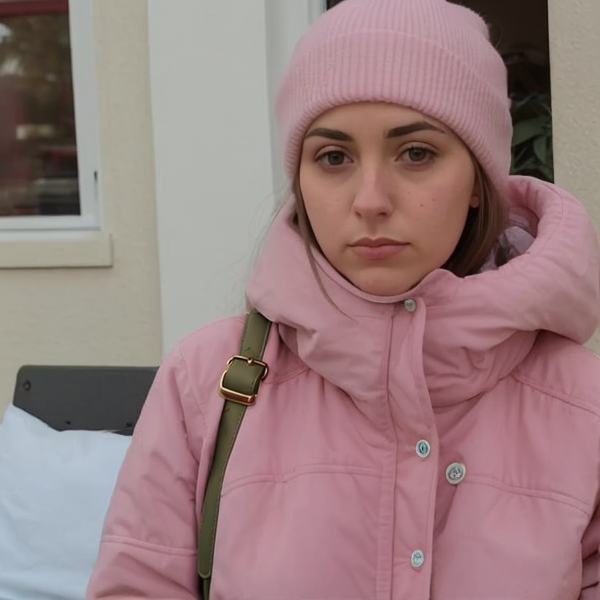
The story of Anzhelika Pretko from the village of Yahidne, Chernihiv Oblast
AUTHOR:
During the occupation, the Russians forced almost all residents of Yahidne to the school basement. Phones and valuables were taken. There was practically nothing to breathe in the basement, but people were allowed outside at most once a day.
One resident of Yahidne Anzhelika Pretko and her family were among those held in the school basement.
“At first, me and my family — my mother, father, and grandparents — hid in the basement at home. But on 5 March, at around 4 pm, Russian soldiers broke into our home and forced us into the school basement. I studied at this school from the 1st to the 9th grade,” Anzhelika explained.
In a panic, the Anzhelika’s family managed to take some essential items, such as medicine, documents and some food. When Anzhelika arrived at the school basement, more than half of the village was already there, including small children, the elderly, the bedridden and the disabled. Everyone came to the village because they thought it would be safer here than in the city. How wrong they were.
At first, the occupiers didn’t take the local’s things, but after two or three days they started taking phones. Anzhelika’s grandparents were sick; the conditions in the basement were unbearable for them. Not only that, but the Russians were not feeding the captives. All the people had to eat was what they had taken with them. The number of people in the basement made for a suffocating atmosphere. With each passing day, the health of Anzhelika’s grandparents deteriorated further. In the end, their legs became almost paralyzed and they grew more and more confused. They couldn’t understand what was happening and where they were.
Understanding their condition, Anzhelika and her parents decided to risk taking them home. Anzhelika’s father asked his fellow villagers and they helped. However, the next day, when the occupiers allowed Anzhelika and her brother to go home for just half an hour to gather some things, they found their grandfather dead. He was lying there, no longer breathing. He was 70 years old.
As of 11 March, about 5 people had died in the school basement. The people asked the Russians to allow them to go and bury them.
The next day, Anzhelika went to the cemetery with her fellow villagers. Russian vehicles drove by. Just a few minutes after that, the shelling began. Anzhelika had no time time to bury her grandfather.
Anzhelika realised she had been wounded in the back and leg. Her father was also wounded in the leg and neither of them could walk. Anzhelika’s mother was also injured, but she could move and run, at least.
They escaped the cemetery as best they could and returned to the school basement, because there were military doctors there, who administered first aid and attended to their wounds. Over the course of the following days, they dressed wounds and removed stitches.
All this time, Anzhelika’s grandmother remained at home, where all the windows and the roof had been badly damaged. She also had nothing to eat. Anzhelika’s family was no longer allowed to go and visit her grandmother. She said that she ate what the soldiers brought her from time to time.
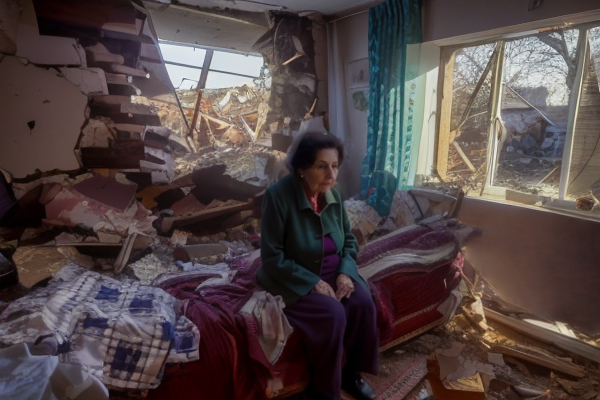
On 30 March, the occupiers once again locked the people in the basement. They just locked the door and refused to let anyone out. The people would normally sit there for several days, and the Russians would allow them out occasionally to breathe fresh air.
This time, however, the people heard the enemy equipment starting to move away. Over the course of the day, they left Yahidne, and the next day the Ukrainian armed forces arrived. They checked all the houses, checked the streets and let the people return to their homes.
Immediately after the liberation of the village, Ukrainian soldiers took Anzhelika’s father to the hospital, because he was still unable to walk. Anzhelika and her family evacuated to relatives in a safer location.
This material was created based on testimonies collected by documenters of the Kharkiv Human Rights Protection Group.
These pictures are created by artificial intelligence. They are NOT real. They are illustrations of the stories we tell. Most of these stories could not have been fixed by the camera. At the same time, there is documentary work by hundreds of Ukrainian and international photographers who produce real, and so much painful, documentation of this war. Check photographs by Oleksandr Glyadelov, Maksym Dondiuk, Mstyslav Chernov and Yevhen Malolietka, Andriy Dubchak, Yulia Kochetova, and many others.