

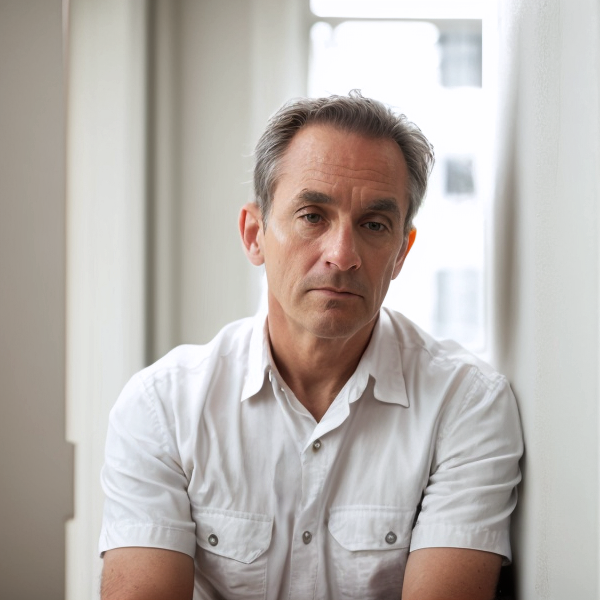
The story of deacon Mykola Serdyuk, whose family escaped Russian occupation from the village of Havrylivka, Kyiv Oblast
AUTHOR:
In February 2022, Mykola Serdyuk understood that a full-scale war was possible, but he refused to believe it. On Monday, 21 February, the clergy gathered to discuss how to behave during wartime, what to do during bombing raids, when there was no power supply and so on. Mykola listened to these instructions, but didn’t think that he would really need them.
And yet full-scale war did come to Ukraine. On 24 February, Mykola’s daughter called and told him that fires were raging in Kharkiv and Vasylkiv. Mykola, who worked in Kyiv, moved from the capital to the village with his family, believing it would be safer there.
“When we were leaving, I saw many cars heading in the opposite direction: from Lyutizh to Kyiv. I also thought: Why are we leaving when people are coming in? Apparently, the people knew that it would be safer in Kyiv because the capital is better protected by the army,’ Mykola recalls.
Mykola planned to leave his wife and grandson in the village and return to Kyiv. However, when he reached the village, he learned that the bridges in Hostomel and Demydiv had already been blown up and he could no longer return to the capital.
On 25 February, the first Russian equipment advanced into Ukraine. It was reported on the radio that they had broken across the border. The Russians pushed through Ivankiv, captured the Chornobyl nuclear power plant and advanced onwards. Mykola heard the approach of the troops.
Mykola later learned that Russians had landed at the Hostomel airfield. The enemy captured the airfield and heavy shelling began. It was scary, because it was so nearby – just 12–13 km from Havrylivka.
On the same day, the power went out in the village because the power lines had been cut somewhere. On 26 February, intense explosions became more frequent. Mykola realised that the Russians were shelling Bucha, Irpin and Hostomel. A lot of Russian equipment passed by Havrylivka and the village was occupied. The local Russians ordered the residents to remain at home and not venture outside. If anyone had to go outside, they were instructed to wear white arm bands.
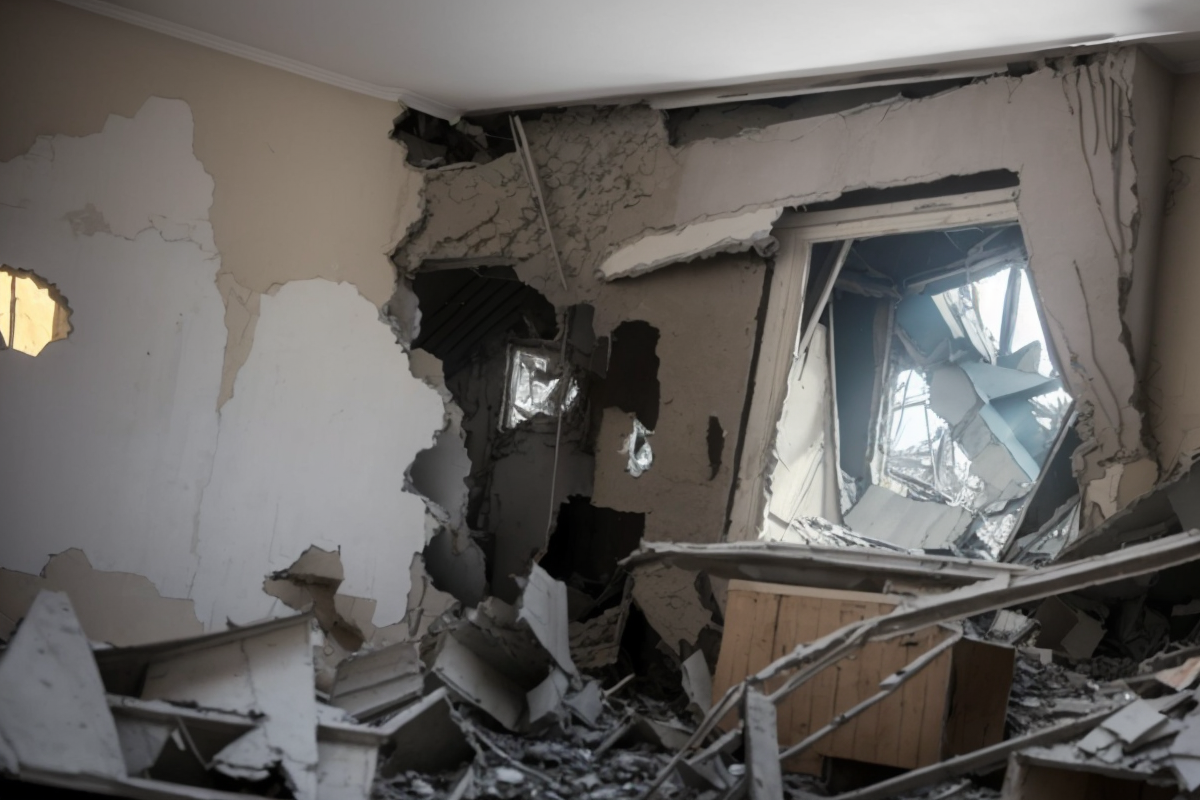
When the windows in Mykola’s apartment were shattered as a result of shelling, the family gathered their essential belongings and ran to hide in the basement of the local school. However, there was no room for them, either there or in the basement of the kindergarten. In the end, the family found shelter in the basement of a grocery store. The shelling was extremely heavy, with explosions heard every 2–3 minutes.
On 8 March, the gas supply in the village was also cut off. People began to carry firewood, take out braziers and light fires to warm themselves and cook food.
Mykola said that Havrylivka was occupied by Kadyrov’s forces, Russian and Belarusian soldiers. Mykola once asked one of them why they had come, especially seeing that no one has a gas and power supply, heat or food. The occupier answered him with sarcasm, “It wasn’t us. It was your own Ukrainians who bombed you.” Mykola told the Russian soldiers to return to where they had came from, and said that the Ukrainians didn’t need liberating from anything. He saw the angry faces of the occupants and fell silent. He turned around and left and, fortunately, the Russian soldiers didn’t do anything to him.
In the meantime, the Russians occupied dachas in the forest and lived there very well. Those houses had fireplaces and there was plenty of food. Mykola learned that soon the Ukrainian troops would launch an offensive. The Russian invaders began to hide in the houses of local residents. Mykola realised he needed to leave as soon as possible, because an intense battle was imminent right there in his own village.
People began to leave by car, while others walked in a large column with white arm bands. Mykola gathered his entire family and risked leaving, despite rumours that the Russians were not letting people go and were even shooting some of them.
Mykola asked everyone to pray and get into the car. An armoured personnel carrier and four Russian soldiers were on guard the first checkpoint. They carefully checked the family, but let them through. Mykola drove through the village, from where the Russians opened fire on Bucha. There were many tanks and all manner of military equipment. Mykola’s family passed the second and third checkpoints with their hands raised and praying aloud.
At the last checkpoint, the occupiers stopped Mykola’s car. He came out with his hands raised and asked in Russian if they would let his family through. The soldiers asked if Mykola had any cigarettes. He replied that his family is religious, so they didn’t smoke. Fortunately, the Russians let Mykola go.
During the next 2-3 km of the road, Mykola counted 20 Russian tanks in the fields. Some soldiers were standing around smoking, others were sitting on tanks with weapons in their hands. Then Mykola’s family saw destroyed cars of civilians and dead bodies, dusted with snow. Everyone became terrified by such a sight.
Mykola and his family finally reached Makariv, where there already were Ukrainian soldiers and blue and yellow flags. This was a joyous sight for the family.
At three o’clock the following morning, the family reached Yavoriv, Lviv Oblast, where volunteers were waiting for them. Mykola and his family were brought to a school, fed, allowed to sleep and rest. Then they found a house nearby, where they settled temporarily.
The family felt they could finally relax, but on the very first night of their stay, the Russians hit the Yavoriv training ground with four rockets. Mykola hadn’t heard such powerful explosions even when he was under Russian occupation. The windows in the houses were blown out and everything shook.
“We had fled our homes, but the war followed us here,” Mykola said. His family has already returned home. Mykola says that his outlook has changed and he has begun to value life, people and his ministry more.
This material was created based on testimonies collected by the Kharkiv Human Rights Protection Group.
These pictures are created by artificial intelligence. They are NOT real. They are illustrations of the stories we tell. Most of these stories could not have been fixed by the camera. At the same time, there is documentary work by hundreds of Ukrainian and international photographers who produce real, and so much painful, documentation of this war. Check photographs by Oleksandr Glyadelov, Maksym Dondiuk, Mstyslav Chernov and Yevhen Malolietka, Andriy Dubchak, Yulia Kochetova, and many others.