

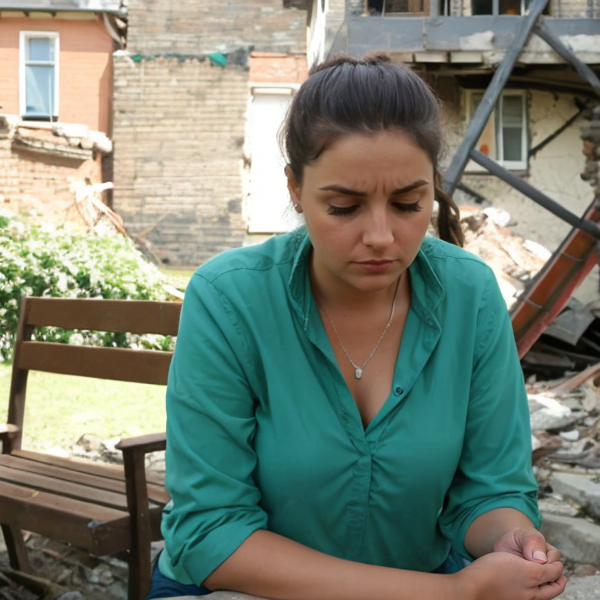
The story of Hanna Sytnyk from the village of Horenka, Kyiv Oblast, whose apartment building was hit by an aerial bomb
AUTHOR:
Hanna had a feeling that there would be a big war. It was talked about on social networks and in various interviews. Everyone knew that there was a concentration of Russian troops on the border. And then foreign ambassadors started leaving Ukraine.
Anna's family had stocked up on food for the New Year. She decided that if they didn't need this food, she would give it away to people.
On February 24, Hanna was set to go to work, but at 5 a.m. her daughter woke her up and said: "Mom, it's started!" The family had talked about the possibility of war in advance, they even had a plan for where and how to hide in the forest.
Of course, that day, adrenaline was running high. Hanna felt both stress and readiness to act: "We all knew what things we were taking. One backpack and that's it. Whole lives packed into single backpacks. I don't know how to put into words that pain and despair. We remained at home until the next day. We gave the soldiers tea because it was very cold."
The first day was difficult, as people were streaming out of Kyiv for almost the whole day, and there were heavy traffic jams. There were a lot of cars, and people took their dogs and cats. But many people still remained in Horenka. From the 3rd to the 4th of March, when the heavy bombardment began, men from the Ukrainian army came and said that the area would soon turn very hot. Then people started leaving en masse.
Hanna's family first went to Puscha-Vodytsia, but this area would soon also fall under Russian shelling . So the family went to their friend in Kropyvnytskyi. They stayed there for a month, and on April 7, Hanna and her husband returned home.
But there was no electricity or gas at home. Since Hanna's house was on the frontline, there were a lot of destroyed buildings around.
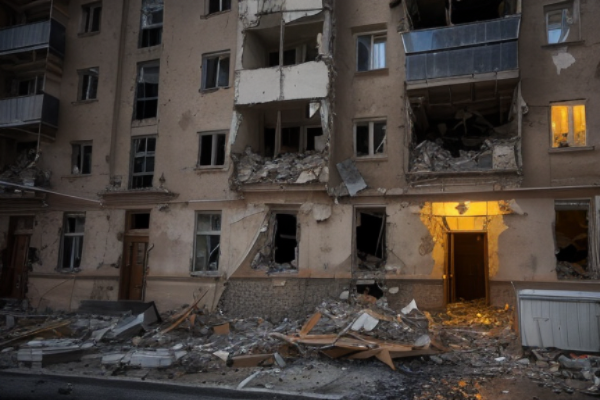
On the night of March 7-8, a bomb was dropped on Hanna's apartment building. The people who were in the building at that time were covered with dust and debris. But within a day, they found a way out and left. All of the eight people survived. Fortunately, save for the windows and doors, Hanna's apartment survived.
"We have two apartments here," Hanna said, "We lived in one apartment, and we were renovating the other. We were supposed to move in May. We had to take my husband's mother, she is disabled. Now it is possible to live in one apartment, but not in the other. There, a shell flew into the room, knocking out the wall and the window."
Hanna is now trying to keep living and encourage other people: "I knew that we would return here. That we would not go abroad. It may sound presumptuous, but I knew I needed to be here. I am not alone: my husband, my children, and the church are with me. We are trying to help people. We bring humanitarian aid, food, drinking water, and we prepare food. We are needed here."
This material was created based on testimonies collected by the Kharkiv Human Rights Protection Group.
These pictures are created by artificial intelligence. They are NOT real. They are illustrations of the stories we tell. Most of these stories could not have been fixed by the camera. At the same time, there is documentary work by hundreds of Ukrainian and international photographers who produce real, and so much painful, documentation of this war. Check photographs by Oleksandr Glyadelov, Maksym Dondiuk, Mstyslav Chernov and Yevhen Malolietka, Andriy Dubchak, Yulia Kochetova, and many others.