

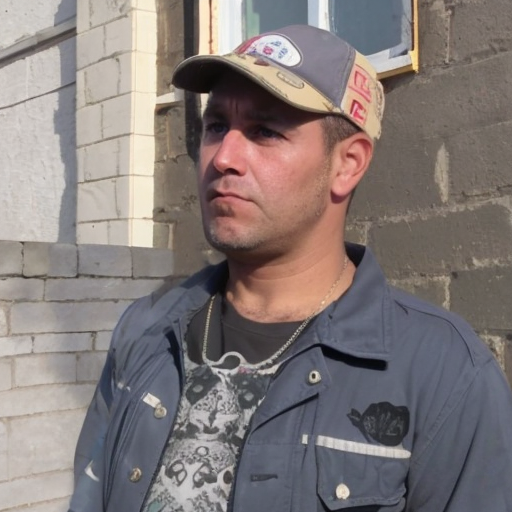
The story of Ihor Nepevnyi from Moshchun
AUTHOR:
35-year-old Ihor has been living in Moshchun for 8 years, along with his wife, two children and grandfather. He is employed in construction and travels to work in Kyiv and Irpin.
“We didn't think there would be a war. It was only when we heard the explosions on the 24th that we realised the full extent of the situation. We were hoping the Russians wouldn’t come here. On the 24th, when it all started, many people came back to us from Kyiv. We thought it was safer here, but it actually proved to be dangerous,” Ihor recalls.
On 24th February, the sight of Russian helicopters was an awful thing for Ihor’s family. He counted about 56 of them, flying very low over the houses. They were flying to Hostomel to bomb the airport. Ihor also saw two SU fighters flying over Hostomel and Bucha. At first, he thought they were Ukrainian planes but later, in a telephone conversation, Ihor’s cousin told him that they were Russian, and that the family had to flee.
On 26th February, Ihor’s uncle Mykola’s house was burned down. Most likely, it had been struck by an IFV. Since the house was wooden, it burst into flames immediately. That day, many roofs were shot through, and there was a large column of smoke in the field from a missile strike.
On 28th February, Ihor took his wife children, and grandfather to the Pushcha-Vodytsia school bomb shelter. He returned to buy cigarettes for the Ukrainian soldiers who had asked him. That same day, three houses burned in Moshchun and there was heavy gunfire and shelling.
On 3rd March, the Ukrainian military asked all the residents of the village to evacuate quickly, because “there would be hell.” Ihor and his family went to the Khmelnytskyi region.
On 14th April, Ihor returned home by himself, because he’d heard about looting in the village and wanted to make sure his own house remained unscathed. Upon arrival, he spent a few days at home and hid all the remaining valuables. Ihor realised that Russian soldiers had been in his yard and basement. He found Russian bulletproof vests and IIFS elements. The Russians had stolen Ihor’s electric bike and charger and his UPS unit. They’d also stolen a lot from Ihor’s neighbours.
Ihor’s house had been damaged by artillery shelling, causing the walls and roof to collapse. Since Ihor is a professional builder, he plans to rebuild the house himself.
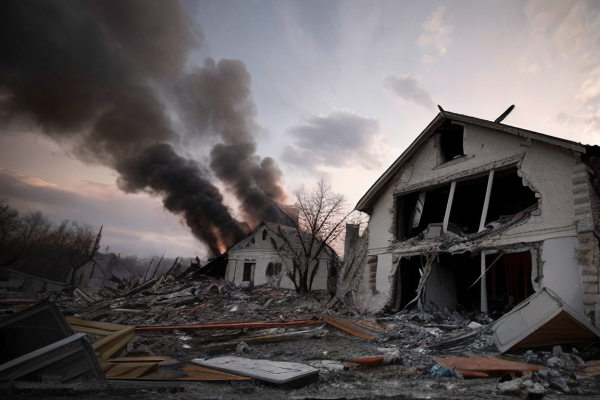
Ihor’s children and wife returned to Moshchun in May and, since then, the family has been living at home. At first, they lived with a neighbour for a few days, whose house was in a better state of repair. Once they had cleaned and fixed things, they returned to their own home.
Ihor says that about 80% of the houses in Moshchun had been destroyed. Russian soldiers had killed many people. “There was a grandpa here, Oleksii... He stayed and he died. Or he was killed; nobody knows for sure. He used to walk around here, and no one had time to come, pick him up,” Ihor explains.
Ihor also said that the houses where the Russians had lived remained intact. At Ihor’s friends’ house, they’d left a terrible mess behind, and used the bath instead of the toilet for some reason. The Russians had even slaughtered a pig in the house of one of Ihor’s neighbours. When the neighbour returned home after the village had been liberated, there were puddles of blood everywhere and the pig's head and skin had been left on the floor.
After the full-scale invasion, Ihor’s attitude towards the Russians changed drastically. “They thought that our life was worse than theirs? On the contrary: when they came here, they saw that everyone had their own house, that we are orderly. My attitude towards them is this: if I see one — I'll knock them out. Because they’re bastards given what they’ve done, ‘liberating’ us… From what have you liberated us? The house that you’ve destroyed?”
The material was created based on testimonies collected by documenters of the Kharkiv Human Rights Group.
These pictures are created by artificial intelligence. They are NOT real. They are illustrations of the stories we tell. Most of these stories could not have been fixed by the camera. At the same time, there is documentary work by hundreds of Ukrainian and international photographers who produce real, and so much painful, documentation of this war. Check photographs by Oleksandr Glyadelov, Maksym Dondiuk, Mstyslav Chernov and Yevhen Malolietka, Andriy Dubchak, Yulia Kochetova, and many others.