

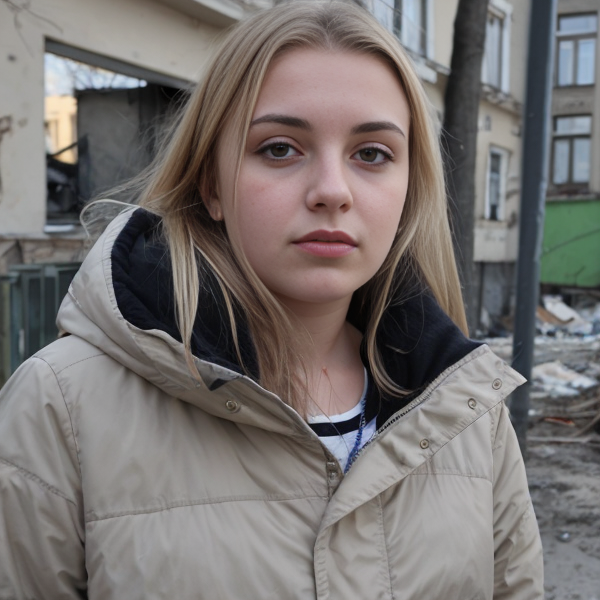
The story of Kateryna Hurina from Kharkiv, whose apartment was destroyed by fire following a Russian missile strike
AUTHOR:
Until 24 February, 21-year-old Kateryna Hurina had been studied hard to complete her bachelor’s degree while working as a graphic designer at a real estate agency. She lived with her parents and pet dog in Pivnichna Saltivka, where she had spent most of her life.
Kateryna loved her district very much. “There were always many families out with their children and walking their dogs. I liked living away from the centre; it was like we had our own little town inside a big city,” she says.
During the night from 23 to 24 February, Kateryna had a dream about war, only when she woke up the morning, war was a reality. Cars alarms were blaring, lights were flashing and explosions could be heard. “I went into the kitchen and my parents were looking out the window. It reminded me of the scene from the TV series Chernobyl, when people stood on the bridge, viewing the burning reactor. We didn’t know what we were going to do,” Kateryna recalls.
Kateryna’s family decided that the safest place in their apartment was the bathroom so that is where they hid during the shelling. Most of their neighbours had gone down to the basement, but it was very cold there. It had not been designed to be a bomb shelter and there was not enough space.
On just the second day of the full-scale invasion, the Russians hit the house of Kateryna’s classmate, the apartment of her father’s friend and then a high-rise building on their street.
On 1 March, Kateryna’s parents went to the shop, leaving her alone with her dog in the bathroom. She heard an incredibly loud explosion and, sitting on the floor, she thought that this was her life coming to an end.
Her friend called her, saying, “Katia, your house is on fire!” A missile had hit the nearby entrance, on the seventh or eighth floor. That day, Kateryna and her parents thought a lot about evacuating but they couldn’t bring themselves to do so. They thought that a second strike wouldn’t come. But it did.
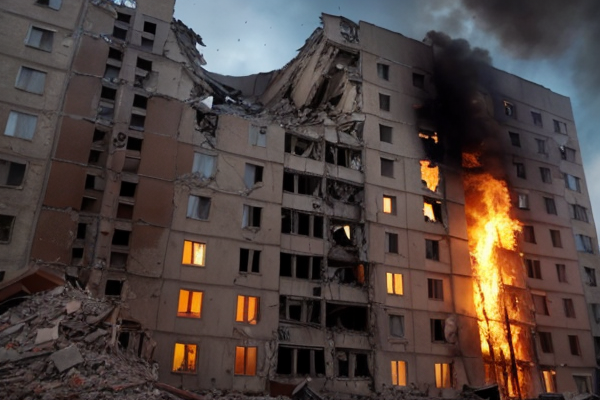
On 4 March, the Russians shelled Pivnichna Saltivka mercilessly. Kateryna’s mother was working at the grocery store and standing at the till when a missile landed. It killed a man standing nearby, crushing him in an instant. Kateryna’s mother hid under the counter and had to crouch beside the dead man, waiting for the shelling to end. Then she ran home, amid burning houses, downed communications lines and dead bodies.
It was then that the family decided to leave Kharkiv and they went to Kateryna’s grandparents in Lyubotyn, Kharkiv Oblast.
“I was happy to be leaving the shelling, but my sense of security didn’t last long. On the evening of 9 March, when everyone was sleeping, I heard the sound of aircraft. I picked up my dog and ran out into the corridor, screaming to wake the family. At that moment, I heard a very loud explosion, everything shook and the windows were blown out,” Kateryna recalls.
When Kateryna’s father went out to check what had happened, he saw two shells in the yard, a metre from the wall, next to where Kateryna had been standing at the time of the explosion. After that, Kateryna was in a terrible emotional state, having terrible dreams and suffering bouts of depression. It was then that her parents advised her to leave the country. Kateryna left, but her parents remained in Lyubotyn.
Meanwhile, Russia continued to bomb Kharkiv. On the night of 9–10 April, a rocket completely destroyed Kateryna’s apartment. She had already made it safely out of the country when her mother sent her a video taken by a passer-by with the words, “That’s it, Katya, we don’t have an apartment anymore.”
After the launch of the full-scale invasion, Kateryna radically changed her attitude towards the Russians. “When the war started in the East of Ukraine and Crimea was occupied, I was 13 years old. Then I thought that it was all Putin and that there were normal people there among the Russians. I even had three friends from there. However, when the shell hit my house on 1 March, they didn’t write anything to me, even though they had seen posts about it on social media. It was then that I realised there is no such thing as a good Russian; they are all responsible. Unfortunately, I needed a missile to destroy my home to understand this,” Kateryna says.
This material was created based on testimonies collected by the Kharkiv Human Rights Protection Group.
These pictures are created by artificial intelligence. They are NOT real. They are illustrations of the stories we tell. Most of these stories could not have been fixed by the camera. At the same time, there is documentary work by hundreds of Ukrainian and international photographers who produce real, and so much painful, documentation of this war. Check photographs by Oleksandr Glyadelov, Maksym Dondiuk, Mstyslav Chernov and Yevhen Malolietka, Andriy Dubchak, Yulia Kochetova, and many others.