

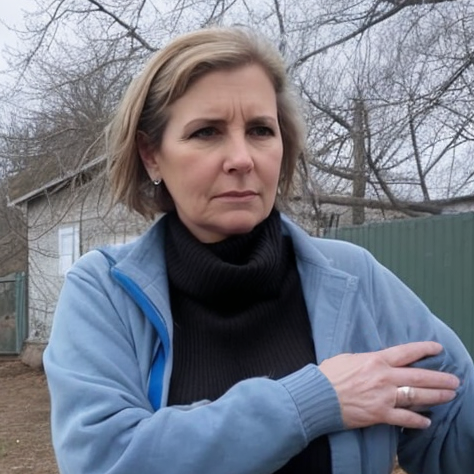
The story of Tetiana Kligunova who, together with her family, survived the occupation of Borodianka
AUTHOR:
Tetiana Kligunova from Borodianka survived the occupation of her village together with her family. She had to to communicate with Russian soldiers and bury her neighbours in her own garden. She admits that she kept herself sane and alive by busying herself with household chores, while her husband managed to make a washing machine that worked without electricity.
On 23 February, Tetiana discussed the possibility of a major war with her friend. It had seemed scarcely believable but when she turned on her television the following day, she heard that Kyiv was being bombed. After that, the oil depot in Borodianka caught fire and, later, Russian soldiers entered the village.
Tetiana’s lived with either others in her house during the occupation: her husband, daughter, son-in-law, her brother-in-law and his partner, two grandchildren and a nephew. Tetiana’s brother-in-law stayed at home at first, but the Russian military came to him and drove him out. They dug a trench in his garden and set up an anti-aircraft gun.
Russians approached Tetiana and asked her where Ukrainian policemen and soldiers were living. However, she replied that this was a peaceful street and that the only people living there were pensioners.
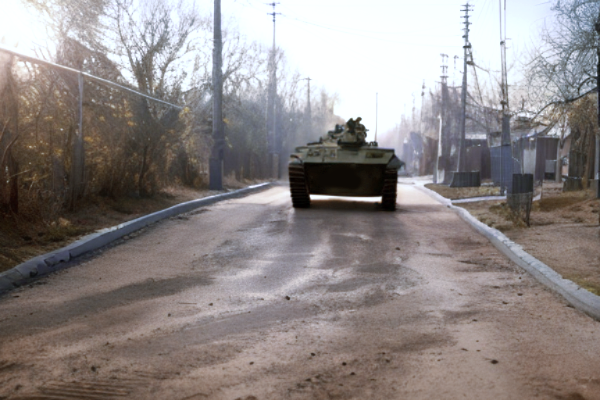
Every morning, Russian armoured personnel carriers would drive down the street where Tetiana Kligunova's family lived, carrying many Russian soldiers with automatic weapons. Every morning and every evening, the Russians would patrol the streets of Borodianka. The local residents were very frightened and tried not to leave their homes under any circumstances.
“I told my grandchildren, ‘Guys, don’t get involved, how do we know what’s on their mind? One of them might just decide to shoot someone out of boredom,’” Tetiana recalls. She also said that the Russian soldiers had drunk all the vodka from the local stores in a week, after which they had run amok, shooting people at random. Tetiana saw a glow from Bucha and Irpin and she realised that terrible battles were raging there. It was then that Tetiana’s family went down into the basement. Tetiana and her relatives collected their belongings, documents and money, but they could not leave Borodianka. They had no time to refuel their car before the Russian occupiers surrounded the village.
When the Russians began to bomb Borodianka, Tetiana did her best to distract herself with work around the house, cleaning and cooking food. Her husband even made a new washing machine from an old one that could operate without electricity, by constantly turning a handle. After eight rockets were dropped on Borodianka, the village was left completely in the dark.
Tetiana and her son-in-law organized a makeshift mortuary in their own garden. They carried their dead neighbours from nearby yards and streets so that they could be buried later. However, Tetiana explained that some people would never receive a proper burial. When an aerial bomb hit one house in Borodianka, its inhabitants were never found. They were blown to pieces.
Fortunately, Tetiana’s house survived, with only the garage, chicken coop and summer kitchen incurring damage. She witnessed Russian soldiers looting neighbouring houses: “I was going outside when I saw a truck approaching. They loaded it up and drove away, and this is happening everywhere, again and again.”
According to Tetiana, Russians are not human. After the full-scale invasion, they have simply ceased to exist for her.
This material was created based on testimonies collected by the Kharkiv Human Rights Protection Group.
These pictures are created by artificial intelligence. They are NOT real. They are illustrations of the stories we tell. Most of these stories could not have been fixed by the camera. At the same time, there is documentary work by hundreds of Ukrainian and international photographers who produce real, and so much painful, documentation of this war. Check photographs by Oleksandr Glyadelov, Maksym Dondiuk, Mstyslav Chernov and Yevhen Malolietka, Andriy Dubchak, Yulia Kochetova, and many others.