

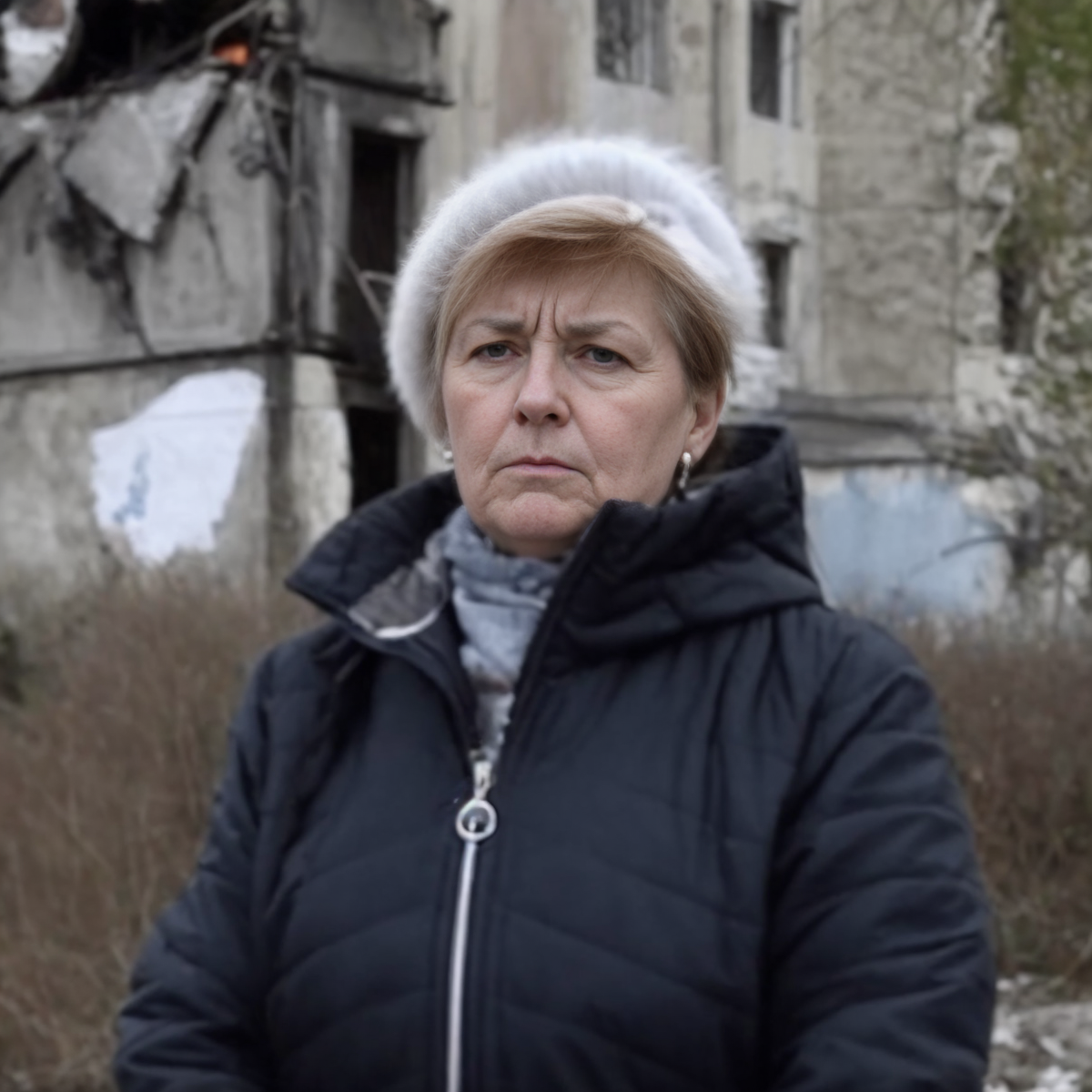
The story of Larysa Tyshchenko, who survived the occupation of Borodianka, Kyiv Oblast
AUTHOR:
Larysa Tyshchenko was born and has lived all her life in Borodianka. On 1 March 2022, a Russian airstrike destroyed her apartment.
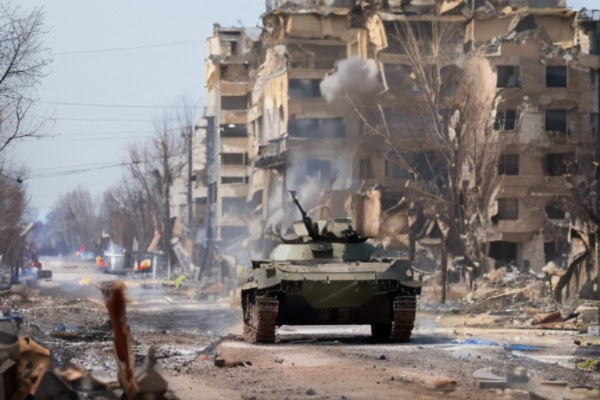
Larysa recalls how, on 26 February, Russian troops had tried to break through to the centre of Borodianka, only to be stopped by the local Territorial Defense unit. The Russians returned on 27 February with tanks, shelling indiscriminately. They fired at residential buildings and a family of five all died as a result of a direct hit on a private house.
“Russian soldiers were sitting on armoured personnel carriers and shooting at civilians who had no time to flee. They were simply gunned down. Every day from 27 February, we were forced to sit in the basement of our five-storey building. At night, we could still go up to our apartment to spend the night and cook food, because the gas supply was still intact. However, on 1 March, the occupiers began shelling Borodianka from the air for the first time," Larysa explains.
First, they bombed two houses near the entrance to Borodianka. At the time, Larysa was sitting in the basement, but the shock wave threw people across the room.
“Everything appeared to have calmed down in the evening, so we decided that we could at least go out and cook. We also began to take out things that we needed to spend the night in the basement. I was in my apartment, with the kettle on and getting ready, dressing in the corridor, when I suddenly heard the roar of a plane. I immediately understood that it was coming from the direction of the Zdvizh River and heading straight for me. I just hid behind the wall; there was nowhere else to go. I didn’t have time to leave the apartment and just waited. I remember the impact: everything was covered in smoke and so much dust that it was impossible to breathe. I realised that I was alive, but I had been knocked down by my wardrobe. It was then that I heard the plane’s second approach, this time coming from the other side,” Larysa recounts the details of that terrible day.
There was no way of leaving the apartment through the front door, because it was blocked by rubble. Men from the Territorial Defence unit arrived at the scene and advised Larysa to make her way through the rubble to the next entrance along and try to go down the stairs that were still intact. Larysa succeeded and, thankfully, escaped unscathed.
Nothing is known about many residents who were at home at the time of the airstrike; not even body fragments have been found. “It’s frightening and hard to comprehend. Personally, I have lost everything: my possessions, my apartment and all my documents. Not a single photograph has remained and it is almost impossible to restore my past life,” says Larysa.
Larysa is convinced that the Russians dropped bombs on residential buildings intentionally, because there was nothing else in the vicinity other than apartment buildings and a kindergarten.
In the days that followed, Larysa hid in the basement of her neighbour Mariia. Throughout this time, convoys of Russian vehicles were passing through Borodianka. It appeared that the enemy had arranged these bombing raids to prevent the Territorial Defence from shooting at their equipment and stopping them from capturing the village.
A little later, Larysa called her son and told him she was still alive; her children had already thought she was gone. Larysa asked her son to take her away from Borodianka, so, once the Russian convoys had passed throught, her son came and took her to the outskirts of Borodianka, where she and her in-laws hid in a basement for several days.
On 6 March, when it was reported that the Russians had started bombing the bridges, Larysa and her relatives left Borodianka. They traveled across Ukraine, spending the night wherever they stopped, in kindergartens and health farms, before settling in first in Zakarpattia and then with friends in an unfinished house in Zhmerynka. Larysa and her children were evacuated there until May.
On 24 February, the first day of the war, Larysa had asked her children to come from Kyiv to Borodianka. “Thank God they didn’t come, because their room at the apartment in Borodianka was completely destroyed by a bomb. It would have been their grave,” says Larysa.
“My classmate Tanya Lykhno’s husband was shot down on the street. He was walking down the street and asked some Russian soldiers for a smoke. They gave him a cigarette, he turned around, and they just shot him in the back. He lay there until night time, then even got up and made it home by himself, but he was dead the following morning,” Larysa said.
People who remained under the occupation throughout that time told Larysa that the Russian snipers would pass the time by climbing to the roof of one of the residential buildings in Borodianka and open fire on civilians, shooting at their feet.
Larysa Tyshchenko now lives in her mother’s apartment in Borodianka. She is happy that she and her family are alive. There are worse things in life than losing an apartment and having the power cut off.
This material was created based on testimonies collected by the Kharkiv Human Rights Protection Group.
These pictures are created by artificial intelligence. They are NOT real. They are illustrations of the stories we tell. Most of these stories could not have been fixed by the camera. At the same time, there is documentary work by hundreds of Ukrainian and international photographers who produce real, and so much painful, documentation of this war. Check photographs by Oleksandr Glyadelov, Maksym Dondiuk, Mstyslav Chernov and Yevhen Malolietka, Andriy Dubchak, Yulia Kochetova, and many others.