


The story of Natalia and Yevhen from the village of Tsyrkuny, Kharkiv Oblast
AUTHOR:
Natalia, Yevhen and their 5-year-old daughter fled the occupation from the village of Tsyrkuny, Kharkiv Oblast in March.
“We spent five days under occupation and realised that we had to leave; there were no communication lines and no power, and shells were flying closer and closer. The incoming strike across the river from where we live was the last straw. We packed our belongings in an hour and put everything in the car: from warm clothes to fishing rods and a chainsaw,” Natalia said.
The family didn’t know what to expect. There was no water supply in the village, but Natalia and Yevhen had their own water column. They left the yard ope for their neighbours to collect water, said goodbye and left.
Natalia, Yevhen and their daughter met many locals on the way, and everyone tried to convinced them that they would not be allowed to pass through the Russian checkpoint and that they would be shot. Some advised tying white rags to the car “so you won’t get shot there and then.”
Natalia’s husband stopped the car near the occupiers’ checkpoint and, taking vodka and cigarettes, he told her he would try to reach an agreement and that, it if didn’t return, she should return home without him. Yevhen even turned the car around to make it easier for Natalia to go back.
While Natalia and her daughter were waiting, another passing grandmother told them that they would definitely not be able to leave. Natalia then saw her husband. They were lucky – the checkpoint was unmanned. They left Tsyrkuny and returned to the cemetery. Other roads were unavailable; this was the only option.
After passing the cemetery, the family continued their journey through fields and mud, the car occasionally swerving from side to side. Eventually, they reached Kharkiv. From there Natalia, Yevhen and their daughter came to an abandoned farm near Bohodukhiv, and now they live there in house that they are slowly renovating.
“We were lucky — the day after we left Tsyrkuny, at the same turn, Russians opened fire on a car with their acquaintances, killing everyone inside. On the other side of the village, closer to Cherkaski Tyshky, there was a convoy of cars leaving. The last one had a family inside — the father and 9-year-old daughter were killed, while the mother and another relative survived with serious injuries,” Natalia explained.
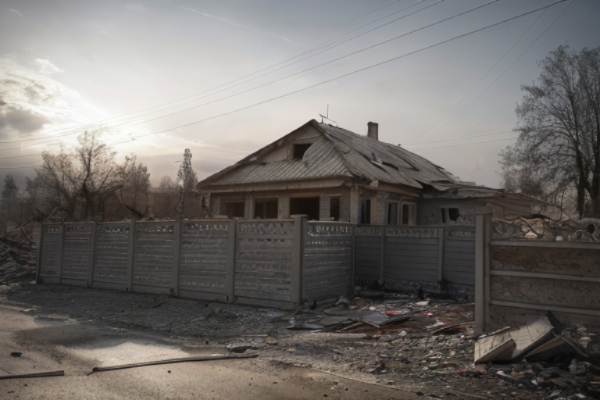
There are almost no houses left intact in Tsyrkuny. Much of the destruction was caused by shelling in the spring, while the remaining attacks were launched after the deoccupation had begun. The windows were blown out in Natalia and Yevhen’s house, the door was damaged, the roof was seriously damaged and cracks spread throughout the house. Natalia notes, however, that, compared to other houses, it is still in quite good condition.
Natalia says that their chances of leaving Tsyrkuny were 50/50. Her friend’s husband was evacuating people in March, and his car came under fire as he left, while his wife remained at home. One day, she was forcibly “evacuated” to Russia as a refugee, taken to the Kaliningrad Oblast and housed in barracks. According to her documents, she will not be able to leave for another three years.
Another acquaintance of Natalia left Tsyrkuny on 28 March after a shell hit their house. Her brother was killed and he is buried in the garden. She tried to leave through Russia, since no one was allowed to Kharkiv. Now she is safe in Germany, but in a very bad moral state.
The Russians looted extensively, wherever they could in the centre of Tsyrkuny. The same was the case in Ruski Tyshky and Cherkaski Tyshky. They took literally everything that could be taken, including carpets and floor coverings. They took cars, mocked the locals and shot their dogs.
“I have nothing to say to Russians now, after what we experienced in Tsyrkuny. Once their soldiers fired at the power plant, we lost power and means of communication. A subscriber to a blog wrote to tell me that she knows we shelled this territory ourselves and that a committee of some kind that has verified this. I blocked her.
“Why do I have to prove anything to them? There are things that I have seen with my own eyes. They watch TV and talk nonsense; there is no point trying to convince them of anything. It is better to direct your energy to yourself, to support your loved ones and your country. It’s not always easy for everyone has their own tragedy, but we will overcome these challenges and become stronger,” says Natalia.
This material was created based on testimonies collected by the Ukrainian Helsinki Union for Human Rights.
These pictures are created by artificial intelligence. They are NOT real. They are illustrations of the stories we tell. Most of these stories could not have been fixed by the camera. At the same time, there is documentary work by hundreds of Ukrainian and international photographers who produce real, and so much painful, documentation of this war. Check photographs by Oleksandr Glyadelov, Maksym Dondiuk, Mstyslav Chernov and Yevhen Malolietka, Andriy Dubchak, Yulia Kochetova, and many others.