

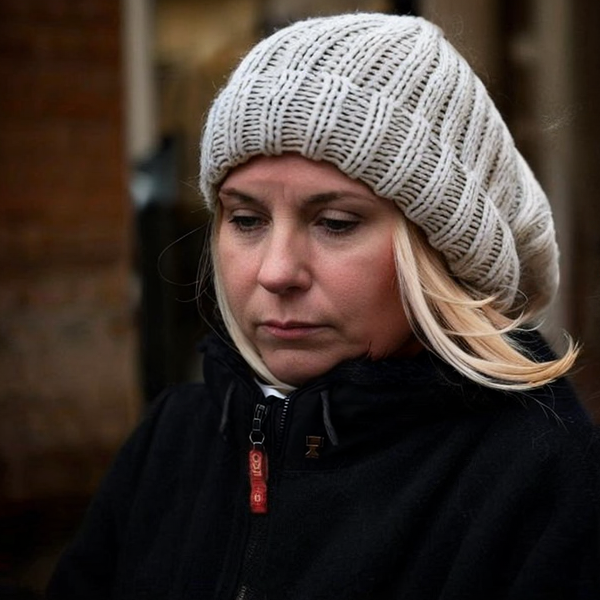
The story of the Stolyuk family from the village of Shybene in Kyiv Oblast
AUTHOR:
During the Russian occupation, Lyubov Stolyuk's 10-year-old daughter was killed by a shell, and her brother Mykola was wounded in the head.
Lyubov Stolyuk met the first explosions of the full-scale Russian invasion in her home village of Shybene in Bucha District. Loud sounds of explosions frightened her children, and 10-year-old Nastya did not leave her mother’s side all day. Lyubov was also worried about her 21-year-old daughter Masha, who is on the autism spectrum. Any change in Masha’s routines could cause her to react unpredictably, and now the war had arrived.
On the evening of February 24, Lyubov and her children decided to temporarily move to live with her brother Mykola on another street in the village. The next day, they saw columns of enemy vehicles moving through the village.
On March 1, Lyubov and her children sat down to eat. Suddenly, they heard the sounds of gunfire. Mykola shouted for them to lie down on the floor. All four of them hid in the room, thinking that it would be safer there. At one point, Lyubov heard a whistle, and something flew into the house. Her brother was already wounded, and he started shouting: "To the basement!".
Mykola and Lyubov grabbed Masha and dragged her out of the damaged house. When they hid her in the basement, they realized that Nastya had not come with them. When Lyubov pulled the girl to her, she realized that she was mortally wounded.
"It was hot running down my hand, I immediately understood that it was blood. I started shouting: "They killed Nastya!". She was hit in the right temple, and her brain came out," Lyubov said.
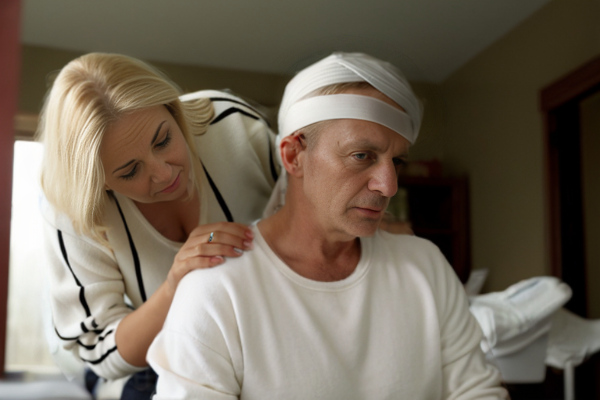
Mykola was hit in the head with the same shell that killed Nastya. He could not receive professional medical attention due to the occupation, so they treated the wound as best they could. After the deadly shelling, the Stolyuk family could no longer stay at home. It was dangerous. Besides, everything there reminded them of Nastya’s death.
The family went to a dacha, where they were sheltered by friends. A few days later, Russian soldiers visited them. They were looking for "the mother of the murdered girl". They had already been told that the child had died. They started apologizing and saying they didn't mean it. "Your little girl died because of your own people. If we hadn't been provoked, this wouldn't have happened," said the Russians.
Later, the Russian military offered to help Lyubov with Nastya's burial. However, there were tanks at the local cemetery at the time, and it was impossible to bury her there. Then one tank was moved, and Lyubov, Mykola, and another neighbor took Nastya's body to the cemetery. They reached the collective farm, and then shelling started again. They had to bury the girl right there, and then dig up and bury her once again in the cemetery.
Nastya was ultimately buried three times. The last one was after exhumation. "When the prosecutor's office came to us from Kyiv, they said that Nastya might have to be dug up again. I said that they could immediately bury me with her. Well, can you imagine that I will see the child for the fourth time? I called the investigator, and asked about it, she said that the request should be made by the prosecutor's office or the court. I hope we won't have to dig up Nastya for the fourth time," — Lyubov said.
The material was created on the basis of testimonies collected by the documentarians of the Ukrainian Helsinki Human Rights Union.
These pictures are created by artificial intelligence. They are NOT real. They are illustrations of the stories we tell. Most of these stories could not have been fixed by the camera. At the same time, there is documentary work by hundreds of Ukrainian and international photographers who produce real, and so much painful, documentation of this war. Check photographs by Oleksandr Glyadelov, Maksym Dondiuk, Mstyslav Chernov and Yevhen Malolietka, Andriy Dubchak, Yulia Kochetova, and many others.