

The story of Svitlana Borodina from Kharkiv
AUTHOR:
Before the war, Svitlana Borodina lived in Kharkiv and worked as a designer in an advertising agency. Since early March, she and her daughter have been living in Drohobych, Lviv Oblast.
A few weeks before the full-scale Russian invasion, Svitlana and her friends began to think about the possibility of war. The teachers at her 16-year-old daughter’s school also raised the matter and told her to prepare for it.
In the evening of 23 February, Svitlana’s daughter asked to sleep with her, because she was feeling anxious. At 5 am on 24 February, Svitlana woke up to strange sounds. At first, she thought that it must have been a special occasion and that people were setting off fireworks. However, 5 am was not a usual time to do this.
“I went out onto the balcony and realised the noise was not stopping. I was living almost in the centre of the city, so I couldn’t see where the noise was coming from. People who lived in the areas where the shelling began saw everything straight away. There were blasts and a glow in the sky. I went onto an acquaintance’s Facebook page and asked what was going on. The answer confirmed my worst fears and I woke my child and told her that, “Sweetheart, the war has started,” Svitlana Borodina recalls.
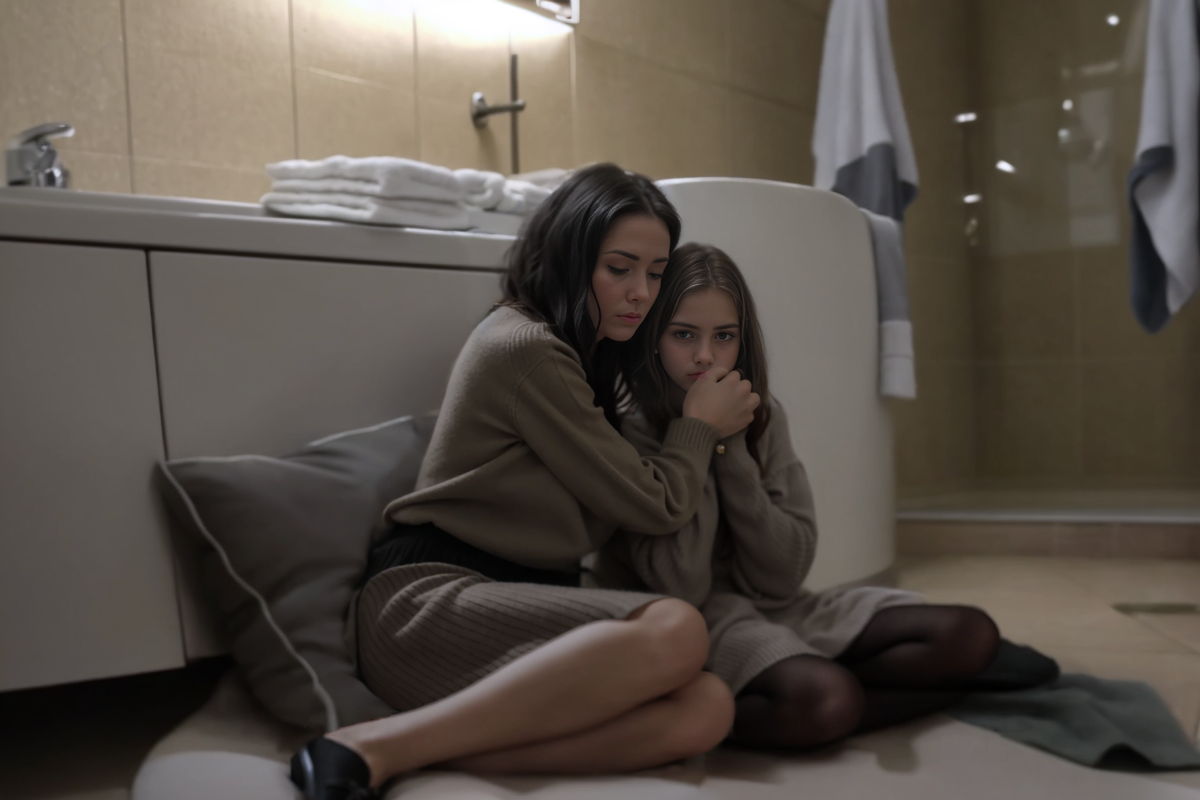
Svitlana later read in the news that explosions had been heard in Kyiv, Chernihiv, Lviv, Odesa and Dnipro. She and her daughter packed their things, spent the next 4 days alone at home, in the bathroom, where they made a bed and spent the night there.
When a fighter jet flew past Svitlana’s house for the first time, it became very scary. After that, she and her daughter went down to the basement and remained there for six days and nights.
When a Russian missile struck the building of the Court of Appeal, which is located 300 metres from Svitlana’s house, she realised that it would not end soon and that she had to leave Kharkiv.
Svitlana wanted to take her old parents with her, but they categorically refused to evacuate. Her mother told her, “Pack your belongings and go; we’ll figure things out here ourselves. You need to get your child out.” So, Svitlana put on a brave face and began preparations to leave.
At first, Svitlana tried desperately to call a taxi, but no one took her call. It took about 45 minutes to walk to the station, but it was a frightening experience, what with constant shooting and explosions all around. In the end, friends helped Svitlana to find a car to pick them up and transport them to the station.
There were a lot of people at the station; Svitlana had never seen such a crowd in Kharkiv, even during the Maidan concerts. She told her daughter that they would take the first train to arrive. As a result, they first took one train to Vinnytsia, and from there they took another to Lviv. Since Lviv was already overcrowded at that time, Svitlana and her daughter were accepted in Drohobych, which is where they still reside.
Svitlana’s parents live in Kharkiv thanks to the help of volunteers and a number of organisations. Svitlana purchased some medicines in Drohobych that were not initially available in the city and she mailed them to her parents.
When Svitlana was still in Kharkiv, she saw a rocket hitting the Nikolskyi mall. There was a lot of smoke and she was extremely frightened. She also said that the Russians had intended to capture the city; they broke through the defence lines somewhere and advanced in tanks, armoured personnel carriers and other combat vehicles.
First, the locals heard automatic gunfire, followed by louder sounds. The Kharkiv territorial defences kept them at bay and a battle began. Russian soldiers occupied School No. 134. They were eventually defeated, but the school was destroyed and cannot be restored. This is a real shame as the school was in a historical building, but it did mean that the Russians were stopped and were unable to capture Kharkiv.
Many of Svitlana’s friends and acquaintances from Kharkiv the nearby area have seen their houses damaged or completely destroyed. She says that Kharkiv residents now simply hate Russians: “I think they would tear them to pieces if they were given the opportunity.”
This material was created based on testimonies collected by documenters of the Kharkiv Human Rights Protection Group.
These pictures are created by artificial intelligence. They are NOT real. They are illustrations of the stories we tell. Most of these stories could not have been fixed by the camera. At the same time, there is documentary work by hundreds of Ukrainian and international photographers who produce real, and so much painful, documentation of this war. Check photographs by Oleksandr Glyadelov, Maksym Dondiuk, Mstyslav Chernov and Yevhen Malolietka, Andriy Dubchak, Yulia Kochetova, and many others.