


The story of Vadym Kutsenko, who spent 110 days in a torture camp organised by Russian occupiers in Kupiansk
AUTHOR:
Before the full-scale Russian invasion, Vadym Kutsenko served in the Armed Forces of Ukraine but he had resigned for health reasons before the 2022 New Year. In February, he came to Kupiansk to run some errands and it was here that he encountered full-scale war and occupation first-hand. During the occupation, one of the locals reported Vadym to the Russians and he ended up in the infamous temporary detention centre at the Kupiansk district police station. According to the Security Service of Ukraine, the Russians illegally detained about 400 Ukrainian citizens in this torture chamber.
On 24 February 2022, Vadym was at a dacha in the village of Hlushkivka near Kupiansk. He was no longer able to leave because the Russians would have detained him as a fugitive at the very first checkpoint. Therefore, he remained in the country and he planted a vegetable garden. They came for him in May.
Two enemy cars drove up to Vadym’s house. The occupiers struck him in the head with a rifle butt and held him face down in the grass. While Vadym lay under the supervision of one of the soldiers, the other six searched the house, kitchen, cellar, attic and outbuildings. They turned everything over, but found nothing. Vadym's hands were tied tightly and he was taken away in an unknown direction.
On the way, the Russians stopped at two more addresses, breaking down the doors with a sledgehammer. They were evidently looking for someone. Throughout this time, Vadym was kept with a bag on his head. His hands were bound with cable ties and they later became very swollen. Dark marks from the ties are still visible on Vadym’s wrists.
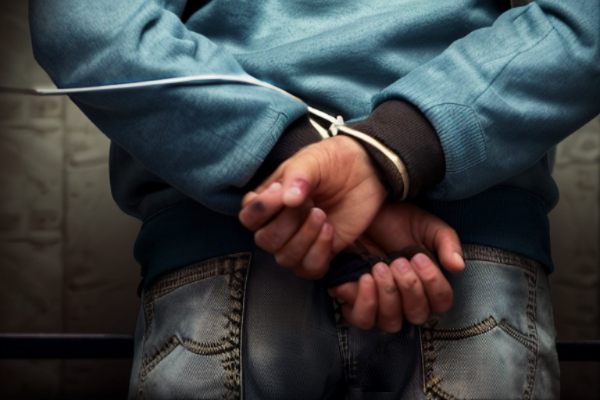
Vadym was brought to the Kupiansk district police department and placed in one of the cells. Since he had served in the Ukrainian army, he was beaten with a heating pipe, an officer’s belt with a buckle, and tortured with electric shock treatment.
“The clamps were attached to me; you can guess where… One clamp on the ear, another – below the stomach. Others were handcuffed from behind. There was a horizontal bar in one of the cells… Some men were beaten so hard that they fainted. There was constant swearing and terrible screaming. I have never heard such screams as the ones I heard during the first days of my stay there,” Vadym recalls.
Vadym was asked about weapons, why he had served in the ATO and whom he knew from there. Of course, he refused to tell them anything.
Vadym was kept in a double cell together with eight other men. Some guys were there simply for breaking the curfew. Some had been there for 10–15 days, and one for an entire month. Vadym spent almost 4 months in the torture chamber.
From time to time, military doctors came to the cells and “resuscitated” those who were already near death. “However, there were times when the occupiers forgot to close the feeding hatches and I saw people being carried out. It was not a box of matches’ not something you can take without being noticed. I saw three or four of them dragging a corpse on sheets,” said Vadym.
Fortunately, Vadym was tortured only during the first days; the rest of the time he was simply held there in his cell; no one ever answered his question of why he was there. So, he just sat where he was and listened to new prisoners being interrogated and tortured.
Vadym said the Russians released some of the prisoners but only if they gave an interview, calling on Ukrainian soldiers to lay down their arms or cooperate with the enemy in some other way. Vadym and many other men could not go against their conscience, so they remained where they were in their cells.
Vadym was released on his 110th day of imprisonment, when the Armed Forces of Ukraine had already begun a counteroffensive in the Kharkiv direction. However, he did not know about this at that point.
“For two days, our feeders were permanently shut. They left us without food or anything else. In the evening of the second day, the prisoners began to knock on the doors. We thought, well, this knocking will result in them beating everyone. It was always like that there: if someone was at fault for something, everyone would be punished. But no one came. We had mostly people of my age in our cell and those who were younger had health problems. The third cell contained regular guys: they dismantled their bunks and started knocking out the bars with them. They probably worked for three hours, all the time occupied with one thought: that the patrol would hear and they would be doomed,” Vadym explained.
However, the guys managed to get out of their cell, find the keys and open the other cells. Vadym and the other prisoners found their documents and left the district police department. Vadym said that it was not only men being held in the torture chamber, but also women, girls, and anyone from whom the Russians were stealing businesses.
At that time, the Russians were still occupying Kupiansk but, little by little, they had started leaving because of the advance of the Ukrainian armed forces. Vadym and the others were afraid that the Russians would start looking for them, but no one touched them. When Vadym returned to his dacha, the Russians did not even check his documents and they didn’t care that he had escaped from the torture chamber. They just came armed with automatic weapons and asked for food.
“My friend asked them where they were from and why they had signed up. They said that they were from Omsk or Tomsk and they they wanted to clear their criminal record. They kept calling us rich, always emphasising that the Ukrainians are rich,” Vadym said.
This material was created based on testimonies collected by the Kharkiv Human Rights Protection Group.
These pictures are created by artificial intelligence. They are NOT real. They are illustrations of the stories we tell. Most of these stories could not have been fixed by the camera. At the same time, there is documentary work by hundreds of Ukrainian and international photographers who produce real, and so much painful, documentation of this war. Check photographs by Oleksandr Glyadelov, Maksym Dondiuk, Mstyslav Chernov and Yevhen Malolietka, Andriy Dubchak, Yulia Kochetova, and many others.