

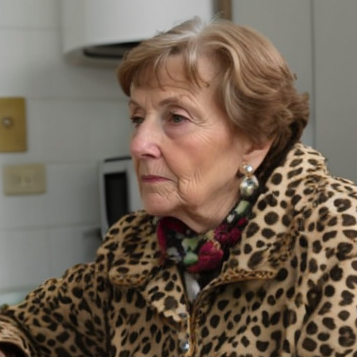
The story of Valentyna Bondarenko from Kramatorsk, forced to leave her hometown due to the Russian invasion
AUTHOR:
Valentyna Bondarenko has been familiar with war since 2014, when hostilities began in eastern Ukraine. It was then that she learned what rockets, Grad missiles and automatic gunfire are all about. As a result of these events, she suffered a stroke.
In February 2022, war returned to Kramatorsk once more. On the day of the full-scale invasion, Valentyna’s neighbors gathered at the front entrance and to discuss their course of action.
Since Valentyna and her husband had nowhere to go, they began to furnish a nearby basement. Young men helped to clean the premises and put up shelving. In the dust and cold, Valentyna and her husband had to sleep on these shelves during the shelling of the city. They were forced to run several times a day from their apartment on the fourth floor to the basement.
Almost all shops in Kramatorsk were swiftly closed. Only one store selling bread and sugar remained open in the House of Trade. Valentyna stocked up on meat in advance, so she and her husband would have enough to eat until they had to leave the city.
Little by little, people began to leave Kramatorsk and there was almost no one on the streets. It reached a point when Valentyna, feeling alone and frightened, convinced her husband to leave.
“We took some items and clothes and went out onto the street. We saw a car in the distance, near the basement and I shouted for it to stop. The driver was reluctant because of the sirens, but eventually agreed to take us to the station,” Valentyna recalls, relating the events of the day of her departure.
There was a huge crowd of people at the station. Valentyna and her husband didn’t care which train to board, for they had no relatives or acquaintances with whom they could stay. When it started to get dark, the air-raid siren sounded and people rushed to hide as quickly as possible in the station building. “The crowd nearly crushed us! I had dropped my bags and thought I’d never survive,” said Valentyna explained.
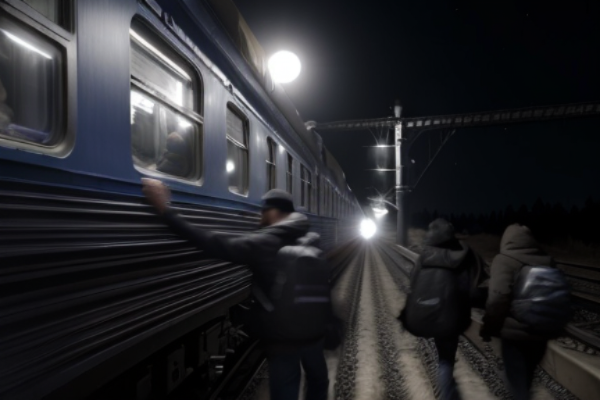
Later, a volunteer took Valentyna and her husband to board a train. People entered the carriages and turned on their torches. The train travelled in the dark and, for safety reasons, it was not allowed to turn on the lights. The journey was slow with occasional, protracted stops in what appeared to be the middle of fields.
When the overcrowded train stopped in Lozova, people started knocking on the door, begging to be let on. There were families with children and, although there were very few seats on the train, these people were evacuated. They related that they had been hiding under the city from bombing raids and, seeing the train, they had made a run for it and tried to stop it.
Valentyna said that the Russians had shelled Kramatorsk every day, striking factories, schools, a boarding school and a hospital. “I think they have destroyed the entire infrastructure and it seems there is nothing left to target. They have now started searching the villages around the city,” she said.
An acquaintance of Valentyna from Kramatorsk witnessed the terrible incident of a woman walking with her daughter, when the small girl’s head was blown off. Valentyna says a similar incident occurred in 2014, when two men were walking from their garages. These are the awful realities of the Russian invasion.
As a result of the bombing, there is now a huge crater near Valentyna’s house. She doesn’t know what has happened to her home and is not sure if she will have anywhere to return to after the victory.
This material was created based on testimonies collected by the Kharkiv Human Rights Protection Group.
These pictures are created by artificial intelligence. They are NOT real. They are illustrations of the stories we tell. Most of these stories could not have been fixed by the camera. At the same time, there is documentary work by hundreds of Ukrainian and international photographers who produce real, and so much painful, documentation of this war. Check photographs by Oleksandr Glyadelov, Maksym Dondiuk, Mstyslav Chernov and Yevhen Malolietka, Andriy Dubchak, Yulia Kochetova, and many others.