

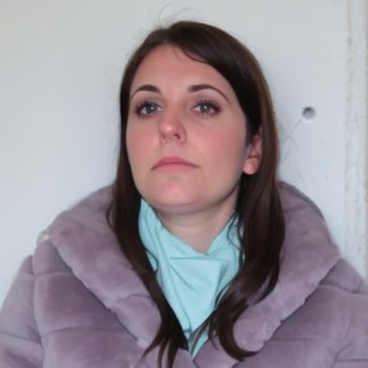
The story of Yevheniia Savynska, who evacuated with her daughter from her native village due to continuous Russian shelling
AUTHOR:
Before the full-scale Russian invasion, Yevheniia Savynska lived with her husband and daughter in the village of Kyinka in Chernihiv Oblast. Constant shelling forced the family to evacuate to Chernihiv, and then to Khmelnytskyi.
Yevheniia's husband is a military man and, at the end of February 2022, his unit was stationed right where the family lived. One day, the Russian occupiers unleashed heavy shelling on the village, killing 35 Ukrainian soldiers.
“When the debris was cleared after the shelling, one boy was found in five parts. I say ‘boy’ because we later found his cap and documents, detailing his name, surname and year of birth — 1998. I remember that his name was Dmytro,” Yevheniia said.
The dead also included a man who had retired a week before the invasion. When the war started, he said he wanted to fight and he asked for a weapon. He died 4 days later. He had already retired; he did not have to do this.
During the enemy attacks, Yevheniia and her daughter hid in the bomb shelter of a nearby house. The people there had put this shelter in order: they had stocked up on provisions, brought things which they had taken with them from the town in the summer, and some gas cylinders. After the shelling, the gas, water and power supplies in the village were all lost, so these preparations turned out to be most wise.
“We didn’t sleep, of course, at all. Everything was booming and shaking. There were a lot of people in the bomb shelter,” Yevheniia recalls the shelling.
At one point, her 11-year-old daughter admitted that she thought she was going to die. Yevheniia asked her how she understood this, to which the girl replied, “I understood that there will be an apple tree, our mulberry tree, there will be sky, there will be sun, and I will be gone.” These adult words shocked and frightened Yevheniia.
There were about thirty people hiding in a small room of 20 square metres. There were also pet cats and dogs. It was a very difficult time, both physically and psychologically; the shelling was intense. Some time later, Yevheniia’s husband took her and her daughter from Kyinka, along with several other people. Later, everyone was evacuated from the village.
Yevheniia moved from Kyinka to Chernihiv and lived with her husband’s parents in the city centre. It was also very loud there, with constant aircraft overhead and multiple explosions. Yevheniia felt needed in her village, where she had helped the soldiers. Here, though, she didn’t know what to do. She got her friends and neighbours together and they decided to donate blood.
“We had just finished giving blood and had left the centre. There were what must have been kilometre-long queues for food, which was very hard to find. Just then, an aircraft flew over Chornovol, which is very close by. Everything was damaged in a radius of 3 km. The girls and I hid for about four or five hours, making short dashes from one bomb shelter to another, then another. Although it is only 20–25 minutes from there to my husband’s parents, the journey took us four and a half hours. His parents, of course, had turned grey, already resigned to the fact we would not return,” Yevheniia explains.
On 17 March, Yevheniia and her daughter left for Khmelnytskyi. At that moment, there was no water or power in the whole of Chernihiv. There were also problems with food. Yevheniia’s husband asked her to leave so that he could do his job and not worry about them.
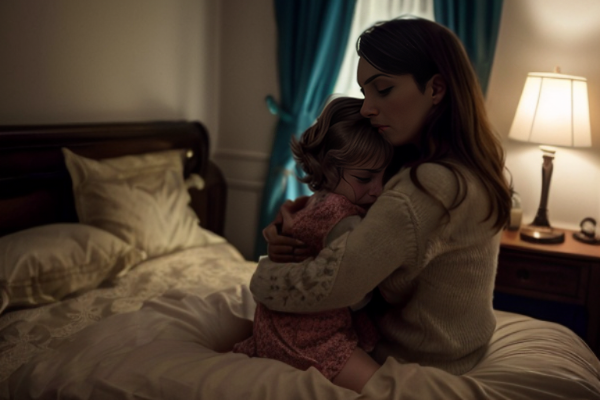
Several days later, they arrived in Khmelnytskyi. Yevheniia woke up at night because her daughter was crying. She said, “Mum, why didn’t I value my life? Why didn’t I appreciate my school, my friends? My hobby groups?”
The girl studied singing, Italian and attended art school. Her drawings had been exhibited at various exhibitions. Then she said, “Why didn’t I appreciate it? We will no longer have the kind of life we had before the war.” It was these words of her daughter that left the most lasting impression on Yevheniia. Not the bombs, but the fact that her child had suffered such moral damage.
This material was created based on testimonies collected by the Kharkiv Human Rights Protection Group.
These pictures are created by artificial intelligence. They are NOT real. They are illustrations of the stories we tell. Most of these stories could not have been fixed by the camera. At the same time, there is documentary work by hundreds of Ukrainian and international photographers who produce real, and so much painful, documentation of this war. Check photographs by Oleksandr Glyadelov, Maksym Dondiuk, Mstyslav Chernov and Yevhen Malolietka, Andriy Dubchak, Yulia Kochetova, and many others.