

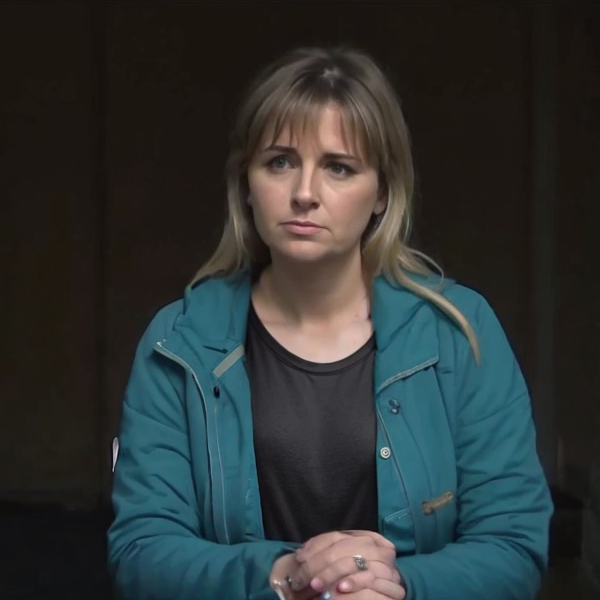
The story of Yuliia Belei, who was able to evacuate her children from Mariupol and is waiting for her husband to return from the war
AUTHOR:
In the first months of the war, Mariupol resident Yuliia Belei lived in a basement with her children, drinking rainwater and burying neighbours in the yard. Yuliia’s husband is a military man and is currently defending Ukraine from Russian invaders.
Before the war, the Belei family lived well, with regular holidays, trips to the sea, the local zoo and parks. Yuliia’s eldest daughter attended school up to the fifth grade, while the two younger ones went to kindergarten. Yuliia worked as a store baker and loved her work.
Since the first shelling in Mariupol began at night on 24 February, Yuliia was unable to go to work. She is relieved that this happened at a time when she was with her children.
When Yuliia heard the sound of aircraft landing, she knew it was somewhere nearby. She called her husband who was on duty and asked him what was going on. However, he didn’t want to worry her and he told her everything was under control and that she should go to bed.
Then Yuliia heard an explosion so loud that she was sure the windows in her apartment had been blown out. She thought it was shelling from truck-mounted Grad missles but then realised it was coming from the air.
At 5 o’clock in the morning, Yuliia heard a new explosion and the news officially declared war. “I don’t understand why they (the Russians) want this war; I don’t understand what they want to prove by this, but they will not have Ukraine, Mariupol either. Mariupol will always remain Ukrainian,” Yuliia explains.
After that, Yuliia woke her eldest daughter and told her that the war had begun. Her husband called her and asked her to leave the city, telling her to take warm clothes and run, to anywhere from there.
Since Yuliia did not have a car, she didn’t know what to do or where to go. Not only that, but she had very little cash to pay for transportation. Yuliia decided to wait for it to get lighter outside, withdraw money from her bank card and think about what to do next.
After standing in a long queue for the ATM, she finally managed to withdraw some cash. On the way back home, Yuliia saw Ukrainian tanks, armoured personnel carriers, Grad truck-mounted missiles and a lot of infantry personnel.
A neighbour then took Yuliia and her children to the centre of Mariupol, where there was less shelling at that time. She tried to leave the city by car, but they were not allowed to pass through the checkpoint. Soldiers explained to her that there was a lot of shooting from the air, and they could be killed on route.
Then Yuliia went to the Terrasport sports complex, where there was a shelter and where people could feel safe. It was very cold there and the people slept on large mattresses on the floor. The children were very scared because of the shelling and worried about their dad. Yuliia’s youngest, three-year-old daughter, did not understand what she was feeling yet and six-year-old Ivanka was worried, constantly tugging at Yuliia and asking her to call her dad. The eldest daughter kept it together very well and did not show panic.
The next day, Yuliia and her neighbour went home to collect their pets and some belongings. On the way, they saw many burnt cars and destroyed houses. It was frightening to go back, with missiles falling nearby. The neighbour floored the car and quickly turned it around.
Yuliia and her children remained in the Terrasport shelter until 1 March. The sports complex published an announcement online that there were a great many people there and there was simply nowhere to accommodate them all. The administration asked anyone who could to take people into their own homes.
So, on 1 March, Yuliia and her daughters went to stay with complete strangers: Serhii and Oksana. The couple took their children to Malynivka, a village 20 km from Mariupol, and returned to help the Ukrainian army. Serhii and Oksana’s apartment was located near Terrasport, on the first floor, from where they could descend into the basement.
There was no heating in the apartment, but there was still electricity, water and a telephone line and Yuliia and the children could still take a shower and prepare food. At one point, Oksana offered to fill a tub with water just in case. Hostilities were already underway, and anything could happen.
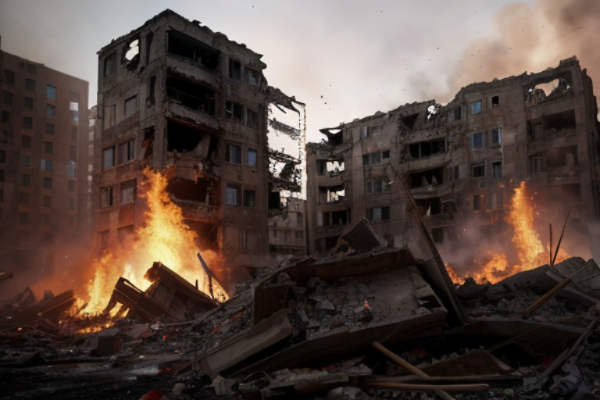
On 3 March, Yuliia woke up from a loud explosion nearby. The power and water were cut off. Yuliia’s family, Serhii and Oksana took warm clothes and some food and went down to the basement. Other residents of the house also gathered there. On that day, enemy planes dropped many bombs, shaking everything, even in the basement.
Heavy shelling continued until 7 March. All contact with relatives was lost. On 4 March, Yuliia tried to leave Mariupol with her children. Serhii and Oksana discovered that many Mariupol residents had organised a convoy to leave, so they too decided to take advantage of this opportunity. They painted the word CHILDREN on the car and set off. Driving through the city, they saw many dead bodies of civilians. Some were covered up, but others were just lying there.
Shortly after their car had joined the column and started moving, missiles began to fall, some hitting the ground right in front of the cars. The cars began to drive around the explosions and the craters, with missiles still falling.
“We realised that the next missile could hit our car. Two cars in front of us had caught fire. They also had the word CHILDREN written on them. And the drivers were also women. There were children there …” Yuliia recalls.
Serhii realised that it was dangerous to travel any further. He turned around and drove back. “The more we drove, the more missiles came falling behind us. It was frightening to look around and all I could do was cover the children as best I could. I told them to sit bent over so, God forbid, not a single shard would hit them,” Yuliia said. People were burned alive in the cars driving in front of Serhii’s car. They were trapped where they were.
Yuliia finally returned to Serhii and Oksana’s apartment and remained there for the next few days. They cooked food on the street with firewood, because the gas pipeline had been cut. However, Yuliia understood that she needed to get out of Mariupol as soon as possible. The explosions were getting closer and louder; the Russians were getting closer.
Then the water supply was cut. Fortunately, it was raining so the people collected the rainwater and drank it. Sometimes they boiled the water, while on other occasions they simply drank it as it fell, when there was no more tea. Yuliia and her neighbours broke off branches from the trees and brewed cherry tea.
Collecting cleaner water for the children meant walking 1–2 kilometres. Yuliia took the risk to fetch under gunfire and shelling. When shells flew nearby, she would fall to the ground, face down in the mud, next to dead bodies.
“Houses caught fire every day; three or four new houses each time. One apartment building with five entrances was destroyed by an aerial bomb and collapsed in the middle from top to bottom. People were living there at the time,” Yuliia said.
Due to the constant shelling, there were too many dead bodies for the city to cope, so the people were forced to bury them themselves. Yuliia and her neighbours buried two soldiers and two local residents who had died from shrapnel wounds.
Yuliia decided to leave Mariupol, despite all the risks, when she met with the Russian soldiers, who were stationed at a school near Serhii and Oksana’s house. One of the occupiers told Yuliia that if she wanted to leave, she had until 4 pm that day. However, the only possible route was through the so-called DPR.
Although Yuliia’s husband had warned her not to use the green corridor of the DPR under any circumstances, she decided she had no choice. She and her children would simply die in Mariupol.
In the end, Serhii took Yuliia and her daughters to Volodarske. There were Russian flags everywhere and Russian soldiers were walking around. Yuliia approached a volunteer and told her she wanted to go to Manhush. The girl replied that Rostov was now the only evacuation route available. Yuliia could not go to Russia. First, she didn’t want to. Second, she is the wife of a Ukrainian soldier which meant she could be captured or even killed.
Yuliia still managed to find people who were evacuating to Ukraine. Despite thorough checks at Russian checkpoints, they reached Berdiansk. From there, Yuliia and her children continued to Zaporizhzhia, and then to Lviv. Today her three children are living in Poland, and her husband continues to fight for an independent, free Ukraine.
This material was created based on testimonies collected by the Kharkiv Human Rights Protection Group.
These pictures are created by artificial intelligence. They are NOT real. They are illustrations of the stories we tell. Most of these stories could not have been fixed by the camera. At the same time, there is documentary work by hundreds of Ukrainian and international photographers who produce real, and so much painful, documentation of this war. Check photographs by Oleksandr Glyadelov, Maksym Dondiuk, Mstyslav Chernov and Yevhen Malolietka, Andriy Dubchak, Yulia Kochetova, and many others.